 Martian Alpha
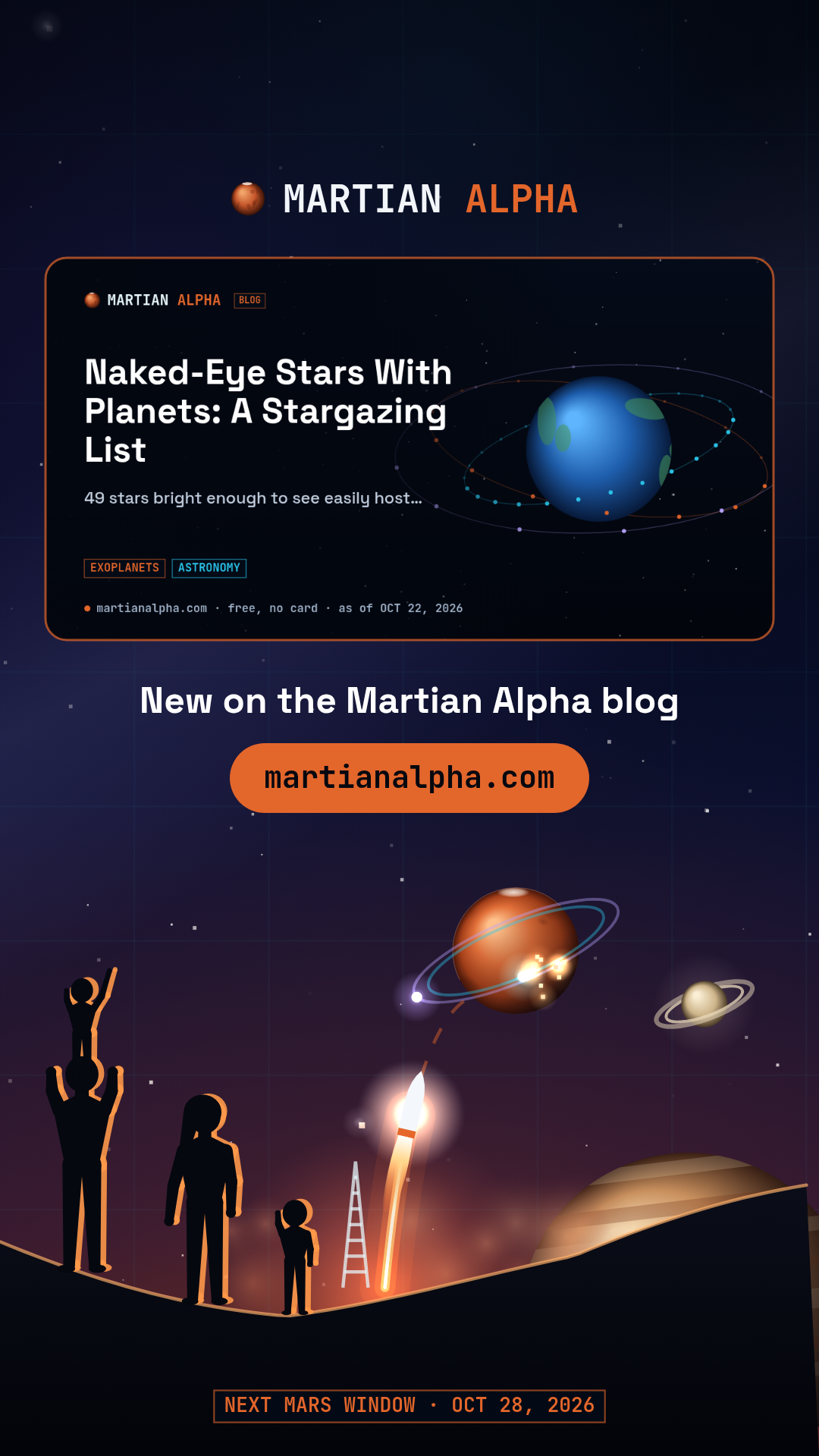
Naked-Eye Stars With Planets: A Stargazing List
49 stars bright enough to see easily host confirmed planets. A list from the NASA Exoplanet Archive, including Pollux, Aldebaran, Tau Ceti and Epsilon Eridani.
You can't see an exoplanet with your eyes, but you can look at the star it orbits. Querying the NASA Exoplanet Archive on October 8, 2026, we found 119 stars brighter than apparent magnitude 6.0 with confirmed planets, hosting 176 of them, and 49 stars brighter than magnitude 5.0 hosting 68. The brightest is Aldebaran (magnitude 0.87), followed by Pollux (1.13). Others on the list include Tau Ceti and Epsilon Eridani, two of the nearest sun-like stars known to have planets.
What "naked-eye" means#
Astronomers measure brightness as apparent magnitude, where a smaller number is brighter and each step of one magnitude is about 2.5 times in brightness. Under a dark sky, people with good eyesight can usually see stars down to roughly magnitude 6; from a suburb or city, it's typically closer to 4 or 5. That's why we used two cutoffs: under 5.0 is realistic for most observers, and under 6.0 is the dark-sky limit.
NASA's Eyes on Exoplanets tool has a display option that shows only naked-eye stars and how many exoplanets have been found around each, if you want to explore it visually.
The data#
All numbers below come from the composite planet table (pscomppars) of the NASA Exoplanet Archive, queried through its public TAP service on October 8, 2026. Distances are the archive's parsec values converted to light-years (1 parsec is about 3.26 light-years). The table held 6,445 planet entries at the time; NASA's overview page says more than 6,000 exoplanets are confirmed.
| Star (common name) | Archive name | Apparent magnitude | Distance (light-years) | Confirmed planets | First found |
|---|---|---|---|---|---|
| Aldebaran | alf Tau | 0.87 | 66.6 | 1 | 2015 |
| Pollux | HD 62509 | 1.13 | 33.7 | 1 | 2006 |
| Gamma Cephei (Errai) | gam Cep | 3.23 | 46.0 | 1 | 2003 |
| Tau Ceti | tau Cet | 3.50 | 11.8 | 3 | 2017 |
| Epsilon Eridani | eps Eri | 3.72 | 10.4 | 1 | 2000 |
| Beta Pictoris | bet Pic | 3.85 | 64.4 | 3 | 2008 |
| Upsilon Andromedae | ups And | 4.10 | 43.7 | 3 | 1996 |
| HD 20794 | HD 20794 | 4.26 | 19.6 | 4 | 2011 |
| Tau Boötis | tau Boo | 4.49 | 51.1 | 1 | 1996 |
| Epsilon Indi A | eps Ind A | 4.69 | 11.9 | 1 | 2019 |
| 61 Virginis | 61 Vir | 4.70 | 27.7 | 3 | 2009 |
| 70 Virginis | 70 Vir | 4.97 | 58.4 | 1 | 1996 |
"First found" is the earliest discovery year among the star's listed planets. The archive lists every planet it has confirmed, and entries can change as papers are published or planets are re-evaluated, so treat this as a snapshot.
Why these stars stand out#
- Aldebaran and Pollux are among the brightest stars in the sky, and both host planets found by the radial-velocity method, which detects the tiny wobble a planet causes in its star's motion.
- Tau Ceti and Epsilon Eridani are close neighbours, roughly 12 and 10 light-years away. Searching nearby sun-like stars for planets is a long-running goal, and Tau Ceti has three entries in the archive, discovered in 2017.
- Beta Pictoris is a young star where planets have been found by direct imaging and radial velocity. The archive lists a 2026 imaging discovery, so its entry is recent.
- Upsilon Andromedae and Tau Boötis were among the first ordinary stars found to have planets; the archive dates the first planet at each to 1996.
- HD 20794 is a faint naked-eye star (magnitude 4.26) at about 19.6 light-years with four listed planets, one added in 2025.
How to find them tonight#
- Pick stars that are above your horizon after dark. Constellation guides help: Aldebaran sits in Taurus and Pollux in Gemini, for example.
- Use a planisphere or a free sky-map app to locate the constellation, then step down to the star. Stars at magnitude 4 to 5 need a reasonably dark site.
- Give your eyes time to adapt to the dark, and avoid looking at a bright phone screen.
- Remember what you are looking at: the starlight, not the planet. Radial-velocity planets can't be seen through a backyard telescope either.
Try it on Martian Alpha#
Martian Alpha's Exoplanet explorer (free account) lets you search the catalogue of confirmed planets by habitable zone, size, distance and discovery method, and find naked-eye stars with known planets that are above your horizon tonight. See also the 3D solar system and the deep-space mission tracker for objects closer to home. The Martian Alpha page is a convenience layer on public data; for the authoritative record, use the NASA Exoplanet Archive.
FAQ#
Can you see an exoplanet with the naked eye?#
No. The planets are far too faint next to their stars. You can see the star they orbit when it is bright enough.
How many exoplanets have been confirmed?#
NASA says more than 6,000. When we queried the NASA Exoplanet Archive's composite planet table on October 8, 2026, it held 6,445 entries.
Which star with a known planet is the brightest?#
Aldebaran, in Taurus, at apparent magnitude 0.87, with a planet first reported in 2015.
What is the closest naked-eye star with a confirmed planet?#
In the archive, Epsilon Eridani at about 10.4 light-years is the nearest on our list, with Tau Ceti about 11.8 and Epsilon Indi A about 11.9 light-years away. Check the archive for newer discoveries.
Does this list change?#
Yes. New discoveries are added, and some planets are revised. The query we used is described above, so you can rerun it.
Sources#
- NASA Exoplanet Archive, composite planetary systems table (TAP service): https://exoplanetarchive.ipac.caltech.edu/ (queried October 8, 2026)
- NASA Science, Exoplanets overview: https://science.nasa.gov/exoplanets/
- NASA Science, Eyes on Exoplanets Tutorial: https://science.nasa.gov/tutorials/eyes-on-exoplanets-tutorial/
This article is for information only and is not financial advice. Do your own research before making any investment.