 Martian Alpha
 DoD Space Contracts: How to Verify Awards on SAM.gov
How to verify 2026 DoD and Space Force space contract awards on SAM.gov: contract types, procurement vehicles and a repeatable tracking workflow.
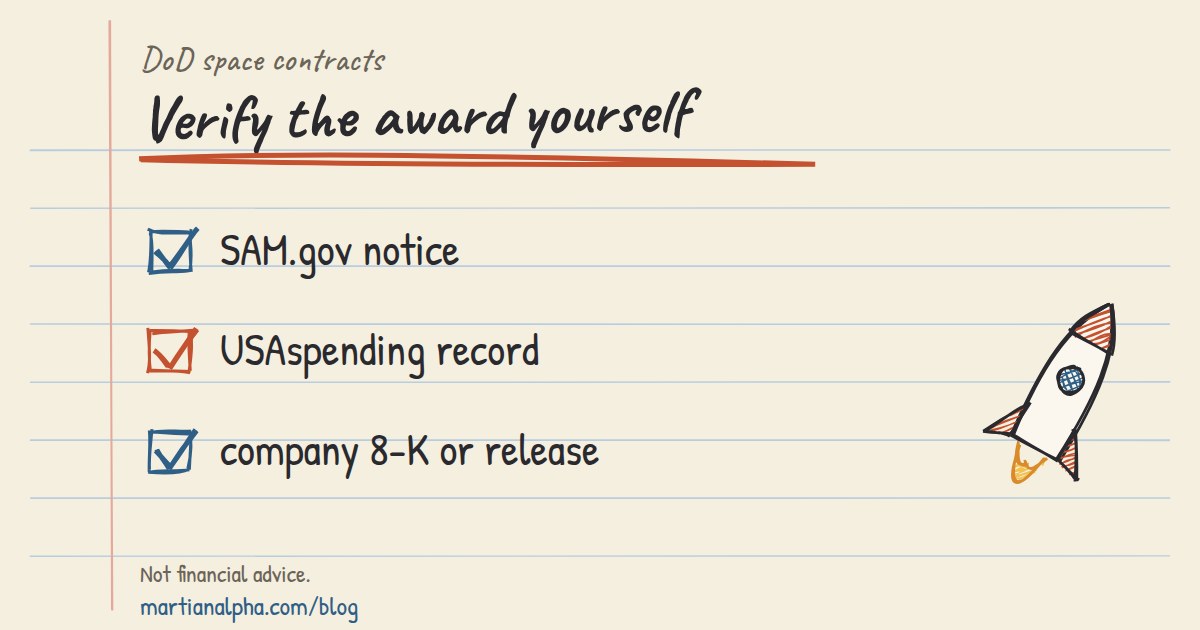
Major 2026 Space Force awards include a $4.16 billion Other Transaction Authority (OTA) agreement with SpaceX, announced May 29, 2026, for the Space-Based Airborne Moving Target Indicator (SB-AMTI) program, plus Starshield task orders tied to the proliferated low Earth orbit architecture. The contracting vehicle differs award by award (OTAs, IDIQ task orders, sole-source actions), so check the vehicle in each official notice rather than assuming one. Analysts tracking award flow should verify each notice directly on SAM.gov, cross-reference Space Systems Command releases, and weigh GAO reporting on cost recovery when assessing program risk.
TL;DR:
- SpaceX received a $4.16 billion OTA agreement for the SB-AMTI program (May 29, 2026), aimed at fielding an initial satellite constellation for tracking airborne targets by 2028; the Space Force said it expects further awards to other vendors.
- Starshield task orders for low Earth orbit communications are awarded through existing contract vehicles; read the contract type in each notice, because fixed-price and cost-type work carry different risks for the contractor.
- Contract types, such as firm-fixed-price and cost-reimbursement, indicate who bears the cost risk and are chosen based on program complexity and competition; labor costs significantly influence award values.
- Award notices often cite specific legal authorities like OTAs or IDIQs, and tracking option exercises helps assess if programs are expanding or stalling.
- A structured workflow using primary sources like SAM.gov, SSC releases, and GAO reports is essential for reliable tracking of Space Force contract activity and program health.
1. Notable 2026 DoD and Space Force space contract awards#
The clearest signal of where Space Force dollars are going in 2026 comes from a handful of large, publicly disclosed task orders. Each carries its own vehicle, dollar figure, and operational purpose, and each is independently verifiable through its SAM.gov notice.
- SB-AMTI (Space-Based Airborne Moving Target Indicator): awarded to SpaceX at a $4.16 billion award, structured as an Other Transaction Agreement paired with IDIQ elements and a multi-vendor pool, announced June 1, 2026; the program builds an airborne target tracking network for the Space Force.
- Starshield/PLEO task orders: multiple 2026 task orders tied to proliferated low Earth orbit satellite communications, some posted under Exceptions to Fair Opportunity and awarded as firm-fixed-price actions, per Sam dated around June 10, 2026.
- Starshield KaHTS task order: a separate SAM.gov entry from September 15, 2026 shows an award citing a sole-source authority clause, with Notice ID, PSC, and NAICS metadata available in the record itself.
Each entry matters for a different reason. SB-AMTI signals the Space Force's growing appetite for space-based tracking as a complement to airborne sensors. The Starshield task orders show how PLEO communications work is being distributed across standing vehicles rather than fresh competitions each time. Readers who want the underlying documents should pull the SAM.gov PDF for each notice rather than relying on secondary summaries.
2. How DoD space contracts work: contract types analysts must know#
Every award sits inside a FAR-defined contract type, and the type chosen tells you who bears the cost risk; our guide to contract type risk goes through each contract family. FAR Subpart 16.1 groups these into two broad families, with incentive and award-fee variants sitting between them.
- Firm-fixed-price (FFP): the contractor absorbs cost overruns, used when requirements and pricing are well understood, common for mature satellite communications task orders.
- Cost-reimbursement: the government reimburses allowable costs plus a fee, typically reserved for development work where requirements are still evolving.
- Incentive and cost-plus-award-fee types: split the difference, tying part of the contractor's payment to performance or cost control, often used on complex space systems where neither party can fully price risk upfront.
Contracting officers weigh negotiation factors under FAR 16.103, including the level of competition, program complexity, and whether the contractor's accounting system can support cost-type billing. A sole-source award to a contractor without an approved accounting system tends to push toward fixed-price structures by default.
One figure worth keeping in mind when reading these award values: the national mean annual wage for aerospace engineers was approximately $134,330 as of May 2023, with aerospace engineering technicians averaging about $81,280. Labor costs at that scale are a meaningful driver behind why cost-type and incentive structures persist on technically demanding programs.
3. Procurement vehicles and authorities worth monitoring#
Award notices reference specific legal authorities, and knowing what they mean helps you read a SAM.gov entry correctly on the first pass.
- Other Transaction Agreements (OTAs): used for prototype and research efforts outside standard FAR procurement rules, frequently paired with follow-on production options.
- IDIQ contracts and task orders: establish a ceiling and scope upfront, then individual task orders get issued against that vehicle as needs to arise, which is how much of the Starshield work has been structured.
- Exceptions to Fair Opportunity: allow a task order under an IDIQ to bypass open competition among existing holders, usually citing a specific FAR authority such as 6.302-1 for a sole responsible source.
- Space Systems Command (SSC) program executive structures: SSC runs acquisition offices for programs including PTS-G and SB-AMTI, and its newsroom releases often carry acquisition approach details absent from the bare SAM.gov notice.
When pulling a record from SAM.gov, check the Notice ID, the NAICS and PSC codes, and the authority clause in the notice text. Published Date reflects when the notice went public, while Award Date is the government's recorded award action, and the two can differ by weeks.
4. What these awards mean for competition and contract performance#
Large awards invite scrutiny, and protests tend to cluster around a narrow set of issues: price realism, technical evaluation scoring, and whether the solicitation's criteria were applied consistently. Reviewing GAO protest decisions alongside award notices gives a fuller picture of where evaluation processes have drawn challenges.
Cost recovery is its own friction point. A GAO report found that the Department of Defense faces difficulty billing for direct and indirect costs tied to commercial space launch support at government ranges, and recommended clearer guidance going forward. That matters for any contractor relying on government infrastructure, since unresolved billing practices can affect margin assumptions on fixed-price work.
Multi-vendor architectures are reshaping competitive dynamics as well. The Space Force's deliberate push toward standardized interfaces and resilient, multi-vendor designs lowers the barrier for newer entrants and reduces the advantage incumbents once held from bespoke, single-vendor designs.
Pro Tip: Track option exercise rates and follow-on task order values, not just headline award figures. They tell you whether a program is actually scaling or stalling after the initial award.
5. Building a repeatable monitoring workflow for award tracking#
A reliable workflow starts with primary sources: SAM.gov for award notices, SSC newsroom releases for program context, and GAO for oversight findings. Save the SAM.gov PDF and note the capture date whenever you pull a record, since notices can be amended or removed.
- Filter SAM.gov by relevant NAICS and PSC codes tied to space systems and satellite communications.
- Set alerts for specific contracting offices, including Space Systems Command program offices handling SB-AMTI and PTS-G.
- Cross-check reported award values against the notice's stated ceiling versus initial funding.
Some platforms provide contract award feeds, launch calendars, and automated alerts to compress this workflow for analysts who need to move from notice to context quickly, without replacing the underlying primary document.
6. What I prioritize when tracking Space Force award activity#
Primary notices on SAM.gov and contracting-office releases carry more weight than secondary reporting, every time. The signals that matter most are the contract vehicle used, initial funding against total ceiling, and the pattern of option exercises that follow.
7. Martian Alpha: a research terminal built for this kind of tracking#
Martian Alpha keeps a contract award feed, launch calendar, and AI-powered company analysis in one terminal, so researchers following Space Force and NASA award activity do not have to rebuild the same monitoring setup from scratch each time a new notice drops.
The platform's core research tools remain free, with paid tiers (Space Enthusiast, Space Professional, Space Entrepreneur, and Space Business) unlocking deeper data and automated alerts for analysts covering publicly traded space contractors. Explore the available plans and see which tier fits your research workflow.
8. Primary sources and authoritative links worth saving#
- FAR Subpart 16.1 and FAR Part 16: the governing rules for contract type selection.
- Sam: the system of record for award notices and metadata.
- SSC newsroom: program-level acquisition context.
- GAO-25-107228: oversight findings on cost recovery.
FAQ#
Does SpaceX have DoD contracts?#
Yes. SpaceX holds multiple Space Force contracts, including a reported $4.16 billion SB-AMTI award in 2026 and various Starshield task orders tied to proliferated low Earth orbit communications.
What are the different types of DoD contracts?#
DoD contracts generally fall into firm-fixed-price or cost-reimbursement categories, with incentive and cost-plus-award-fee types used when risk needs to be shared. FAR Subpart 16.1 outlines how contracting officers choose between them based on program maturity and competition.
What is the average salary for a Space Force contractor?#
There is no single published figure for "Space Force contractor" salaries since pay varies by role and employer. For a public benchmark, the Bureau of Labor Statistics publishes national wage estimates for aerospace engineers and related occupations each year.
How much of SpaceX is government contract?#
SpaceX's exact revenue breakdown between government and commercial contracts is not publicly disclosed in detail. What is verifiable is the scale of specific awards, such as the $4.16 billion SB-AMTI agreement, which analysts can track alongside other disclosed Starshield awards on SAM.gov.
Sources#
This article is for information only and is not financial advice. Do your own research before making any investment.