 Martian Alpha
 Contract Type Risk: How 4 Contract Families Split Cost
FAR and DFARS backed advice for procurement leaders on contract type risk: how four contract types allocate cost and when to transition.
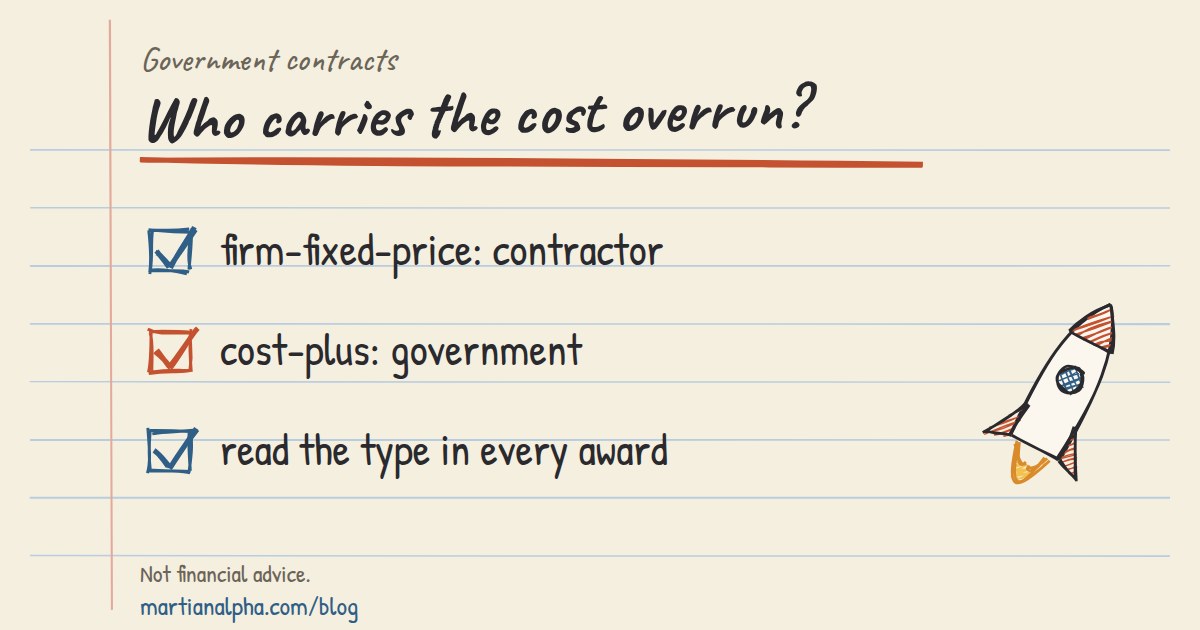
Contract type risk measures who carry cost and performance uncertainty on a given agreement. Firm-fixed-price arrangements push that burden onto the contractor, while cost-reimbursement contracts shift it toward the buyer. The practical rule for decision-makers: match the contract type to how well the requirement is understood, then document why.
TL;DR:
- Fixed-price contracts are ideal when requirements are well-defined and stable, as they place most cost risk on the contractor and require minimal oversight.
- Cost-reimbursement contracts shift financial and performance risk to the buyer, demanding rigorous monitoring and proper contractor accounting systems to control costs.
- Incentive contracts with shared risk elements depend heavily on accurate estimates and clear performance metrics, as their effectiveness in controlling costs varies with their share lines and ceilings.
- Contract type selection should be based on how mature the technical scope is, with formal documentation of the justification to improve auditability and reduce risks of misclassification.
- For high-uncertainty technology projects, a hybrid approach that transitions from cost-reimbursement to fixed-price as design knowledge matures tends to mitigate scope and schedule issues.
What contract type risk measures and why it matters#
Contract type risk describes the allocation of financial and performance responsibility between a buying organization and a contractor. At one end of the spectrum sits firm-fixed-price, which places maximum cost responsibility on the contractor. At the other sits cost-reimbursement, which places more of that burden on the buyer, according to FAR Subpart 16.1. The choice is not cosmetic. It determines who absorbs a cost overrun, who owns schedule slippage, and how much oversight the buying organization must staff to keep the arrangement honest.
The policy objective behind this allocation is straightforward: align incentives so both parties have a reason to control cost and deliver on schedule. A contracting officer choosing a fixed-price vehicle is betting that the requirement is stable enough for a contractor to price with confidence. Choosing a cost-reimbursement vehicle is an admission that nobody can price the work accurately yet, so the buyer accepts more exposure in exchange for flexibility.
FAR Part 16 and its supporting guidance give contracting officers a governing framework for this decision, and they explicitly recommend combining contract types or transitioning to firm-fixed-price as a requirement matures, per Subpart 16.1. DFARS supplements this with financial mechanics specific to defense acquisitions.
Three anchors define the regulatory landscape:
- FAR 16.1 sets the general policy on contract type selection and the factors that justify each choice.
- DFARS provisions add profit and working-capital adjustments tied specifically to the type of contract used.
- GAO reports supply the empirical record of how these types perform once contracts are underway.
How the main contract types allocate financial and performance risk#
The four contract families used most often in practice sit on a continuum from contractor-heavy risk to buyer-heavy risk, with the monitoring burden rising as the risk shifts toward the buyer.
- Firm-fixed-price places nearly all cost risk on the contractor, who agrees to a set price regardless of actual cost. This works best when requirements are mature, stable, and priced against reliable historical data, and it demands the least monitoring from the buyer.
- Fixed-price incentive and cost-plus-incentive-fee (CPIF) contracts split risk through negotiated share lines, a target cost, and a fee formula. The mechanics of the deal, not just its label, determine how much of an overrun lands on the contractor versus the buyer.
- Cost-reimbursement contracts shift the larger share of cost risk to the buyer, who pays allowable costs plus a fee. GAO-09-921 found these vehicles carry higher government risk for cost escalation and require adequate contractor accounting systems and continuous surveillance to keep spending in check.
- Time-and-materials and labor-hour contracts leave the buyer exposed to cost risk on labor rates and materials, since there is no ceiling tied to a defined deliverable. These fit situations where the scope cannot yet be pinned down, such as early-stage technical support.
The administrative burden tracks the risk allocation almost exactly: fixed-price needs the least buyer oversight, cost-reimbursement needs the most, and incentive contracts fall in between depending on how tightly the share lines and ceiling are drawn.
Incentive contracts: how share lines and ceilings allocate risk#
Incentive contracts use four moving parts: a target cost, a target fee, a contractor share ratio, and a ceiling price. The final fee is calculated as target fee plus the difference between target cost and actual cost, multiplied by the contractor's share. Change any one of those inputs and the risk split changes with it.
- A generous share ratio and a high ceiling favor the contractor on overruns.
- A tight ceiling and low share ratio push more of the risk back onto the buyer once costs pass the ceiling.
- Department of Defense guidance treats a 50/50 share and a 120% ceiling as a starting point, though actual negotiated terms vary by program, according to GAO-21-181.
GAO-21-181 found that fixed-price-incentive contract elements materially affect who bears cost risk, and it recommended that agencies assess whether FPI use is actually achieving the cost and schedule outcomes it was meant to produce. That finding matters because an incentive structure only works when the buyer has solid independent cost estimates and clear performance metrics behind it. Without those, the incentive becomes a negotiating exercise rather than a risk-control tool.
How contracting officers choose a contract type#
FAR 16.104 lists the factors contracting officers must weigh before settling on a type, and treating this as a checklist rather than a formality reduces selection errors later.
- Degree of price competition and whether comparable pricing data exists.
- Maturity of the requirement, meaning how well the technical scope is defined.
- Adequacy of the contractor's accounting system to support cost-type billing if needed.
- Urgency of the need and the period of performance involved.
- Extent and nature of subcontracting planned under the award.
Before locking in a contract type, document the pricing data reviewed, the requirement's maturity level, and the rationale for rejecting a firmer-price alternative. A file that shows this reasoning holds up far better under audit than one that simply states a conclusion.
Watch for red flags that point toward a cost-type instrument: undefined technical scope, no comparable historical pricing, or a contractor whose accounting system has not been validated for cost reimbursement.
Pro Tip: Build the contract-type justification memo before drafting the solicitation, not after award, so the rationale drives the vehicle instead of justifying it retroactively.
Working capital adjustment under DFARS#
DFARS 215.404-71-3 adds a working-capital adjustment to the profit objective specifically to account for contract type risk. This adjustment applies to fixed-price contracts that include progress payments, not to cost-plus arrangements, since cost-plus contracts already shift risk to the buyer through their reimbursement structure.
- DFARS lists normal values by contract type, for example around 5.0% normal for firm-fixed-price with no financing and around 3.0% normal for firm-fixed-price with progress payments, per DFARS 215.404-71-3.
- The table also gives designated ranges around those normal values, giving contracting officers room to adjust based on specific contract facts.
- Contracting officers may vary from the normal value when the file documents a reason, and the adjustment directly affects the profit objective used in negotiation.
Implications for complex or novel technology programs#
Fixed-price contracts tend to break down when scope or requirements are still immature, producing change orders, disputes, and schedule slips that erase the pricing certainty the vehicle was supposed to deliver. This pattern shows up repeatedly in high-uncertainty technical work, including satellite and launch vehicle development, where design maturity often outpaces the ability to price it firmly.
A hybrid approach, moving from cost-reimbursement to fixed-price as knowledge gates are cleared, tends to manage this better than committing to one vehicle for the life of the program.
- Set explicit transition triggers tied to design reviews or earned value thresholds rather than calendar dates.
- Require an independent cost estimate before locking in a fixed-price ceiling on technically immature work.
- Verify the contractor's accounting system is adequate before relying on cost-type billing.
- Document the transition plan in the contract file so the rationale survives program turnover.
Balancing incentives, oversight, and documentation#
Incentive structures are a tool, not a substitute for good cost estimating. A generous share line does not fix an unstable requirement, and a tight ceiling does not replace independent cost analysis. Procurement leaders get better outcomes by documenting the contract type rationale up front, planning the transition to firmer pricing as knowledge matures, and investing in the monitoring capability that cost-type work demands. Start with the FAR 16.104 checklist above and keep the primary sources on file when the decision gets questioned.
Sources#
Use FAR and DFARS for the governing rules, GAO reports for empirical evidence on how contract types perform, and World Bank procurement guidance for broader risk-management practice.
- Subpart 16.1 - Selecting Contract Types | Acquisition.GOV
- GAO-09-921: Contract Management: Extent of Federal Spending under Cost-Reimbursement Contracts Unclear and Key Controls Not Always Used
FAQ#
What are the different types of contract risks?#
Contract risk generally covers cost risk, performance risk, and schedule risk, each allocated differently depending on the contract type chosen. Firm-fixed-price concentrates cost risk with the contractor, while cost-reimbursement shifts more of it to the buyer, per FAR Subpart 16.1.
What are the four different types of contracts?#
The main families are firm-fixed-price, fixed-price incentive, cost-reimbursement, and time-and-materials or labor-hour contracts. Each sits at a different point on the risk spectrum, with firm-fixed-price placing the most cost risk on the contractor and cost-reimbursement placing the most on the buyer.
What is contract risk?#
Contract risk is the chance that either party ends up bearing unplanned cost, schedule, or performance consequences under the agreement. The contract type chosen at award largely determines how that exposure is split, which is why FAR guidance treats type selection as a risk-allocation decision rather than a paperwork step. To see these contract types in real awards, read how to verify DoD space contracts on SAM.gov.
What is a C type contract?#
There is no single standardized "C type" contract across procurement frameworks; the term usually refers informally to a cost-reimbursement or cost-plus arrangement. In those contracts, the buyer pays allowable costs plus a fee, and GAO has flagged this structure as carrying higher risk of cost escalation for the buyer, per GAO-09-921.
This article is for information only and is not financial advice. Do your own research before making any investment.