 Martian Alpha
 How to Read a Space Company's S-1 Before It IPOs
A section-by-section guide to a space company's S-1: price range, use of proceeds, dilution, voting control and lock-ups, with Voyager and SpaceX filings.
When a space company plans to go public in the US, it files a registration statement on Form S-1 (Form F-1 if it is a foreign private issuer) on the SEC's EDGAR system. To read one well, look at five things first: the price range on the cover of the amended S-1, the use of proceeds, dilution, who controls the votes after the IPO, and the lock-up in "Shares Eligible for Future Sale". The final prospectus, filed under Rule 424(b)(4) on pricing day, replaces the estimates with the actual numbers.
The S-1 filing sequence, using a real space IPO#
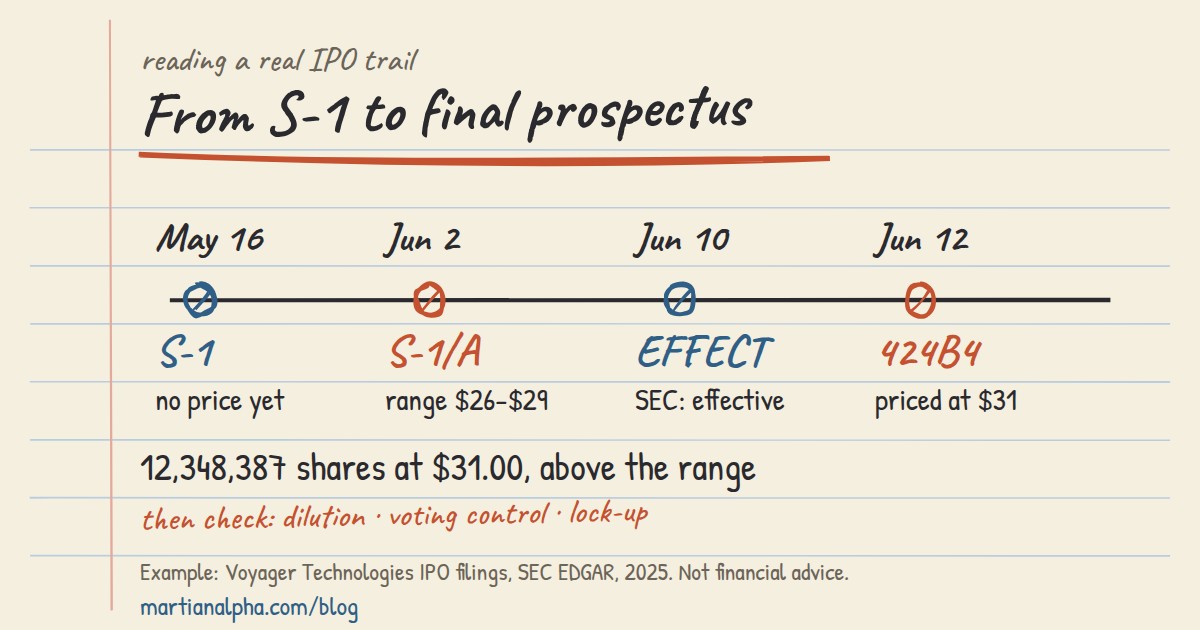
An IPO leaves a predictable trail of filings. Voyager Technologies, a defense and space company that listed on the NYSE as VOYG in 2025, shows the whole sequence on its EDGAR page:
| Date (2025) | Filing | What it added |
|---|---|---|
| May 16 | S-1 | First public registration statement: business, risks, financials. No price yet |
| June 2 | S-1/A | Amendment with an expected price range of $26.00 to $29.00 for 11,000,000 shares |
| June 5 | S-1/A | Second amendment |
| June 10 | EFFECT | The SEC declares the registration statement effective; the offering prices that evening |
| June 11 | 8-A12B | Registers the Class A shares on the exchange |
| June 12 | 424B4 | Final prospectus: 12,348,387 shares at $31.00, above the range |
SpaceX followed the same pattern a year later. Its EDGAR filings show an S-1 on May 20, 2026, amendments on June 1 and June 3, the 8-A on June 10, effectiveness on June 11 and the final prospectus on June 12, when the shares began trading on Nasdaq as SPCX.
The first S-1 is the long read. The amendments are where the numbers that move the decision appear, so check the latest S-1/A before you draw conclusions.
The sections that matter, in reading order#
A space company's prospectus follows the same structure as any other. Voyager's final prospectus runs from "Prospectus Summary" through "Underwriting" plus audited financial statements. You don't need to read it front to back. This order gets you to the important parts fastest:
- Cover page. Shares offered, price or price range, exchange and ticker, and the class of stock being sold. If there are two share classes, it says so here.
- The Offering. A one-page summary: shares outstanding after the IPO, the underwriters' option to buy more, the use of proceeds in a sentence, and voting rights.
- Use of Proceeds. What the company says it will do with the money.
- Capitalization and Dilution. How the balance sheet changes, and how much book value per share a new buyer gets compared with the price paid.
- Risk Factors. Long, but the space-specific risks are worth reading in full (see below).
- MD&A and the financial statements. Revenue mix, backlog, cash burn and how much debt there is.
- Principal Stockholders and Description of Capital Stock. Who owns what and who controls the vote.
- Shares Eligible for Future Sale and Underwriting. Lock-ups, and when insider shares can be sold.
Five things to check in a space company S-1#
1. Price range versus final price#
The price range first appears in an amended S-1, and the final price appears in the 424B4. Voyager's June 2 amendment expected $26.00 to $29.00 for 11,000,000 shares. The final prospectus sold 12,348,387 shares at $31.00, so both the share count and the price ended up higher than the range. A move like that tells you demand during the roadshow was strong. It doesn't tell you what happens to the price after listing.
2. Use of proceeds#
Read this section for how specific the plans are. Voyager estimated net proceeds of about $348.9 million at $31.00 (about $402.3 million if the underwriters bought their extra shares). It said it would use the money "primarily to fund strategic growth initiatives", including research and development and capital assets, with a portion possibly going to acquisitions and the rest to working capital. Vague language is normal. What matters is whether the money mainly funds growth, pays down debt, or buys shares from existing holders.
3. Dilution#
The Dilution section compares the IPO price with net tangible book value per share after the offering. Voyager's prospectus says buyers at $31.00 would experience immediate dilution of $23.22 per share. Large dilution is typical for companies whose value lies in technology, contracts and future growth rather than in hard assets. It isn't a red flag by itself, but you should know the number.
4. Who controls the vote#
Many recent space IPOs use two share classes, and that changes how much say public shareholders have.
| Voyager (VOYG) | SpaceX (SPCX) | |
|---|---|---|
| Votes per Class A share (sold in IPO) | 1 | 1 |
| Votes per Class B share | 15 | 10 |
| Founder's voting power after the IPO | About 62.8% (Dylan Taylor, about 10.1% of the stock) | About 82.4% (Elon Musk) |
| Other | "Controlled company" under NYSE rules | Class B holders also elect a majority of the board |
Both figures come from the cover pages of the final prospectuses (Voyager, SpaceX). The practical meaning: buyers of Class A shares get economic exposure, but board elections and major decisions sit with the founder.
5. Lock-ups and future share sales#
"Shares Eligible for Future Sale" tells you how many shares could come onto the market later and when. In Voyager's case, the company, its directors and officers, and holders of substantially all of its stock agreed not to sell or hedge for 180 days after the prospectus date, subject to exceptions, and the cornerstone investors' IPO shares were not locked up. Lock-up expiry dates are worth putting in a calendar, because a large number of shares becoming sellable at once is a known source of price pressure.
Also check the underwriters' option. SpaceX's underwriters could buy up to 83,333,333 extra shares at the IPO price within 30 days. Voyager's underwriters bought their full option: the company announced the closing of 14,200,645 shares, 1,852,258 more than the 12,348,387 priced.
Risk factors that are specific to space companies#
Every prospectus has generic risk factors. In space company filings, these are the ones worth reading word for word:
- Customer concentration and government dependence. How much revenue comes from NASA, the Department of Defense or a few commercial customers, and whether contracts can be cancelled for convenience.
- Launch and mission risk. Dependence on one launch provider, the cost of a failed launch, and whether satellites or payloads are insured.
- Regulatory approvals. FAA launch licences, FCC and ITU spectrum filings, and export controls (ITAR/EAR) that limit foreign sales.
- Fixed-price development contracts. Cost overruns on firm-fixed-price work hit margins directly.
- Funding needs. Whether the company expects to need more capital after the IPO, which points to future dilution.
A good habit is to compare the risk factors with the MD&A. If a risk is described as remote but the financials show it already happening (say, losses on fixed-price contracts), believe the financials.
After the IPO: the filings that follow#
A listed space company then files 10-Qs, a 10-K, 8-Ks for material events, and proxy statements, and its insiders file Form 4s when they trade. SpaceX's first 10-Q, for example, was filed on August 4, 2026. Before the IPO, the same company's fundraising usually shows up only in Form D notices, which our guide to tracking private space company funding with Form D explains. Together, Form D, the S-1 and the post-IPO reports cover a space company's life from private funding rounds to public reporting.
Following space IPOs on Martian Alpha#
Martian Alpha's IPO & SPAC Pipeline Monitor tracks pre-IPO space companies from SEC S-1 and F-1 filings, so new registration statements in the sector show up in one list instead of scattered across EDGAR searches. It is part of the paid Space Entrepreneur plan; the plans page has the details. On the free plan, the catalyst feed tags regulatory filings, earnings and contract awards for listed space stocks, and the Private Company Directory lists private space companies that could file next. Whichever tool you use, the S-1 on EDGAR is the source of truth.
FAQ#
What is the difference between an S-1 and a 424B4?#
The S-1 (and its amendments) is the registration statement a company files before its IPO, with an estimated price range added in an amendment. The 424B4 is the final prospectus filed after pricing, with the actual offering price and share count. For Voyager, the June 2, 2025 S-1/A showed a $26.00 to $29.00 range, and the June 12 424B4 showed the final $31.00 price.
Where can I find a space company's S-1?#
On SEC EDGAR. Search the company name, open its filing list and filter by form type S-1 (or F-1 for foreign private issuers). Each filing has the full prospectus as an HTML document. The amended versions are labelled S-1/A.
How long is a typical IPO lock-up?#
It varies, so read the "Shares Eligible for Future Sale" and "Underwriting" sections of the specific prospectus. Voyager's lock-up for the company, its directors and officers and nearly all existing holders ran 180 days after the prospectus date, with exceptions, and its cornerstone investors' IPO shares were not locked up.
Why do space companies use dual-class shares?#
Founders often want to keep control of long, capital-intensive programs after going public. In Voyager's IPO, Class B shares carry 15 votes each, giving the founder about 62.8% of the votes with about 10.1% of the stock. SpaceX's Class B shares carry 10 votes each, and Elon Musk holds about 82.4% of the voting power.
Is an S-1 investment advice?#
No. An S-1 is a legal disclosure document written by the company and its lawyers, and it mostly describes risks. This guide explains how to read one; it isn't a recommendation to buy or sell any stock.
Sources#
- Voyager Technologies final prospectus (424B4), June 12, 2025
- Voyager Technologies S-1/A, June 2, 2025 (price range)
- Voyager: pricing of initial public offering (press release, June 10, 2025)
- Voyager: closing of initial public offering (press release)
- Space Exploration Technologies Corp. final prospectus (424B4), June 12, 2026
- SpaceX: pricing of initial public offering (investor relations, June 11, 2026)
- EDGAR filing lists: Voyager Technologies (CIK 1788060), Space Exploration Technologies Corp (CIK 1181412)
This article is for information only and is not financial advice. Do your own research before making any investment.