 Martian Alpha
 How to Track Private Space Company Funding with Form D
Use SEC Form D filings to track private space company funding: where to find them, what each item means, real filings, and the limits to know.
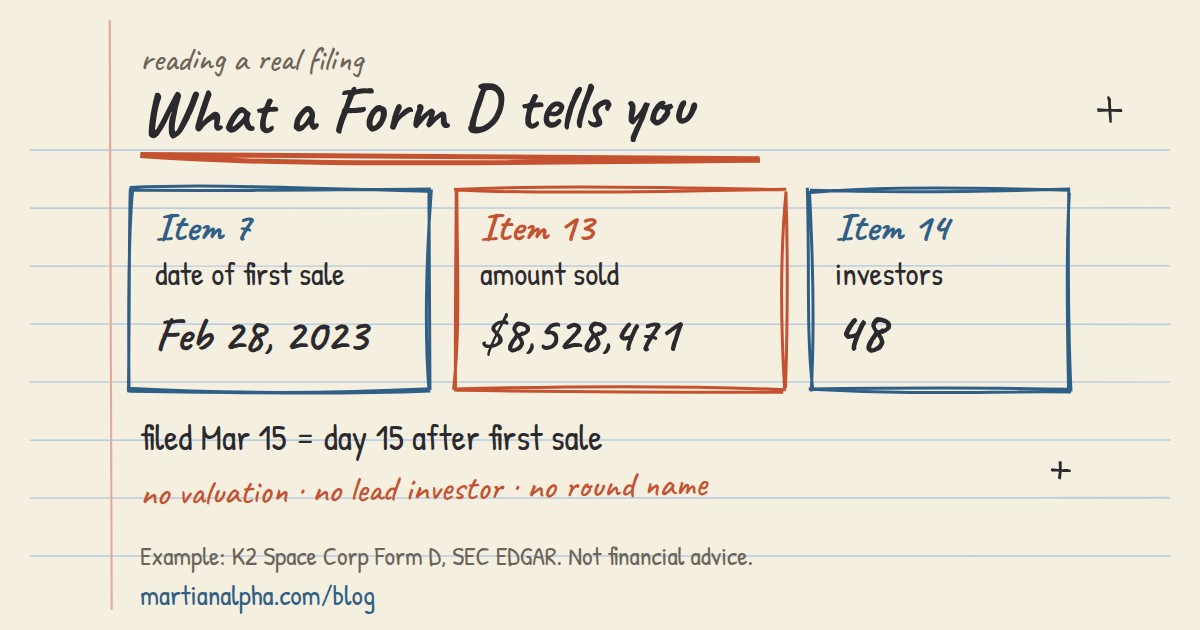
Private space companies don't publish quarterly earnings, but most of them do leave one public trace when they raise money: a Form D notice on the SEC's EDGAR system. To track private space company funding, search EDGAR for the company's Form D filings and read Item 13 (offering and sales amounts), Item 14 (number of investors) and Item 7 (date of first sale). Form D tells you that money was raised, roughly when and how much. It does not tell you the valuation, the round name or who led it.
What Form D is and when it has to be filed#
Form D is a short notice that a company files after selling securities without registering them with the SEC. It covers offerings under Rule 504, Rule 506(b) and Rule 506(c) of Regulation D, and under Section 4(a)(5) of the Securities Act. Almost every venture round for a US startup, from seed to late-stage, relies on one of these exemptions, which is why Form D is the most consistent public record of private funding.
The timing rules are set out in 17 CFR 230.503 and repeated on the SEC's Form D filing page:
- The deadline is 15 calendar days after the first sale. The first sale is the date the first investor becomes irrevocably committed to invest, not the date the money arrives. If day 15 falls on a weekend or holiday, the deadline moves to the next business day.
- The filing is free and electronic. The SEC charges no fee for a Form D or an amendment, and every notice is filed through EDGAR.
- Amendments follow the offering. A company must amend its Form D to fix a material mistake, to reflect most changes in the information, and every year on the anniversary of the last filing if the offering is still open.
That 15-day clock is why a Form D often appears on EDGAR a week or two before a startup announces its round, and sometimes when no announcement ever comes.
Where to find a space startup's Form D filings#
There are three free ways to pull filings, depending on whether you know the company's name.
- EDGAR company search. Search the company's legal name (for example "Astranis Space Technologies Corp.", not "Astranis") on EDGAR and filter the filing type to D. Each filing page has a readable version of the form and the raw
primary_doc.xml. - EDGAR full-text search. The full-text search covers every electronic filing since 2001. Search a quoted name or keyword and limit the form type to D and D/A. It is the best way to catch filings made under an unfamiliar legal name or by a special purpose vehicle.
- The SEC's Form D data sets. For screening many companies at once, the SEC publishes the structured fields of every Form D as quarterly data sets. They currently run from September 2009 to June 2026 and are updated each quarter.
The catch is that Form D has no space or aerospace category. Item 4 asks the issuer to pick one industry group from a fixed list, and the closest options are "Manufacturing", "Telecommunications" and "Other Technology". All three space companies in the examples below chose "Other Technology", alongside thousands of software and hardware startups. You can't filter EDGAR down to "space" by industry code. You need a list of the companies first.
How to read a Form D, item by item#
The official form has 16 items. These are the ones that matter for tracking funding, and how to read each one.
| Item | What it shows | How to read it |
|---|---|---|
| 1. Issuer's identity | Legal name, entity type, year of incorporation | Check that it is the operating company and not a fund or SPV that holds its shares |
| 3. Related persons | Executive officers, directors and promoters | New directors often signal a new lead investor taking a board seat |
| 4. Industry group | One category from a fixed list | No space option; most space companies pick "Other Technology" |
| 5. Issuer size | Revenue range, or "Decline to Disclose" | Many startups decline; a disclosed range is a rare hard data point |
| 6. Exemption claimed | Rule 504, 506(b), 506(c) or 4(a)(5) | 506(b) means no public marketing; 506(c) means only verified accredited investors could buy |
| 7. Type of filing | New notice or amendment, and the date of first sale | The date of first sale is the closest thing to a "round date" |
| 9. Securities offered | Equity, debt, options or other rights, pooled fund interests | SAFEs and convertible notes are usually marked as debt, as an option or other right to acquire a security, or as "Other", not as equity |
| 13. Offering and sales amounts | Total offering amount, amount sold, amount remaining | The core number. "Indefinite" is allowed for the total offering amount |
| 14. Investors | Number who have already invested, and whether any were non-accredited | A small count with a large amount means a few large checks |
| 15–16. Fees and use of proceeds | Sales commissions, and payments to officers or directors | Usually zero for venture rounds; large figures deserve a closer look |
Two rules from Regulation D help explain the exemption box. Under Rule 506(b), the company can't use general solicitation, and it can sell to no more than 35 purchasers who aren't accredited investors in any 90-day period. Under Rule 506(c), it can advertise the offering publicly, but every purchaser must be an accredited investor and the company must take reasonable steps to verify that.
Three real space company filings, read line by line#
All three figures below come straight from the XML of each filing on EDGAR, read on 2026-10-04.
| Filing | Filed | First sale | Amount sold | Investors | Exemption | Revenue disclosed |
|---|---|---|---|---|---|---|
| K2 Space Corp | 2023-03-15 | 2023-02-28 | $8,528,471 | 48 | 506(b) | Decline to disclose |
| Astranis Space Technologies Corp. | 2021-04-19 | 2021-03-19 | $280,821,725 | 58 | 506(b) | Decline to disclose |
| Firefly Aerospace Inc. | 2026-07-08 | 2026-06-23 | $22,000,000 | 18 | 506(b) | Over $100,000,000 |
What each one teaches:
- K2 Space filed exactly 15 days after its first sale. The amount sold equals the total offering amount, so the raise was complete when it filed. Forty-eight investors in one round is typical of a seed-stage raise with many smaller checks. The filing gives no valuation and no lead investor.
- Astranis filed three separate Form D notices in April 2021 (two on April 15 and one on April 19). One round in the press can appear as several filings, and one filing can bundle more than one closing, so add up the filings carefully before comparing with a headline number.
- Firefly Aerospace trades on Nasdaq as FLY, yet it still filed a Form D in July 2026. Public companies use Regulation D for private placements too. For a listed company, a Form D is a pointer to check its 8-K and 10-Q filings for the full terms. It also shows a disclosed revenue range ("Over $100,000,000"), something private startups rarely give.
Five traps when you use Form D to track funding#
- No valuation, ever. Form D reports dollars sold, not the price per share or the post-money valuation. Treat any valuation you see attached to a Form D as coming from somewhere else.
- Special purpose vehicles look like companies. Search "Impulse Space" on EDGAR full-text search and the hits include "Tamarack Global Impulse Space V, LP", a separate fund entity that filed an amended Form D on 2026-08-26. EDGAR also lists an "Axiom Space PML SPV 1 LP". These are investment vehicles that may buy shares in a round or on the secondary market. Their filings are not the company's own primary raise and shouldn't be added to its funding total.
- Timing lags in both directions. The first sale can come weeks after the term sheet, and the notice can come up to 15 days after that. Rolling closes stretch the record further through amendments.
- Some raises never appear. Companies that raise outside Regulation D, foreign issuers selling only abroad, and some debt and grant financing (including government contracts) won't produce a Form D. A missing filing is not proof that no money was raised.
- Amendments restate the whole form. Every amendment must give current answers to every item. Read the latest D/A as the current picture, and don't add it on top of the original.
Quick checklist before you log a funding event: right legal entity (not an SPV) · new notice or amendment · date of first sale · amount sold versus total offering · investor count · exemption type · cross-check with the company's own announcement.
Turning Form D into a funding timeline#
For a single company, put every Form D and D/A in date order in a simple table: filing date, date of first sale, amount sold, number of investors and exemption. Then match each row to a press release or news report if one exists. The gaps tell you something. Several filings with no announcement can mean quiet insider or bridge rounds. A large announced round with no matching filing can mean the money came through an entity or an exemption you haven't found yet.
The same discipline applies to government money. A Form D tracks private capital, while contract awards show up in federal records instead: Martian Alpha's free contract awards page lists recent US awards to space companies from USAspending.gov, and the launch calendar covers the operational milestones that usually sit between funding rounds.
When a private company finally files to go public, the Form D trail gives way to a registration statement. Our guide to reading a space company's S-1 before it IPOs covers that next stage.
Using Martian Alpha's Private Company Directory#
Martian Alpha's Private Company Directory solves the "list of companies first" problem. It groups private, pre-IPO and IPO-filed space companies by sector (launch, satellite, in-space services, ground systems, Earth observation, defense-space and space software), and each profile shows the company's total funding, last known valuation and a dated funding history, combining curated profiles with filings pulled from EDGAR. It is part of the free plan, with five company profile views a day. Paid plans raise that limit and add the Funding & Valuation Tracker (Space Enthusiast, $5/month) and the IPO & SPAC Pipeline Monitor for S-1 and F-1 filings (Space Entrepreneur, $50/month). See the plans page for the full breakdown.
To be clear about the limits: entries that come from Form D are added automatically, so the directory is the place to find the company and the date of a filing, and EDGAR is the source of truth for the amount, the investor count and the exemption. Use the directory to build your list, then read each filing with the checklist above.
FAQ#
Is Form D public?#
Yes. Form D notices are filed on EDGAR and anyone can read them for free, including the structured XML version. The SEC also publishes all Form D fields as quarterly data sets.
Does Form D show a startup's valuation?#
No. Form D reports the total offering amount, the amount sold, the amount remaining and the number of investors. It does not include share price, valuation, round name or the identity of investors other than related persons such as officers and directors.
How long after a funding round is Form D filed?#
The notice is due within 15 calendar days after the first sale, which is the date the first investor is irrevocably committed. If day 15 is a weekend or holiday, the deadline moves to the next business day. Filings usually appear within about two weeks of the first commitment, but the round may have been agreed earlier.
Do public space companies file Form D?#
They can. A listed company that sells shares in a private placement under Regulation D files a Form D like any private issuer. Firefly Aerospace, which trades on Nasdaq, filed one in July 2026 for a $22,000,000 offering.
Why can't I find a Form D for a space startup that announced a round?#
The company may have filed under a different legal name, the money may have come through an SPV or a parent entity, the round may have used an exemption that doesn't require Form D, or the filing may still be within its 15-day window. Try EDGAR full-text search with the founders' names or the company's legal name before concluding nothing was filed.
Sources#
- SEC: Filing a Form D notice
- 17 CFR 230.503: Filing of notice of sales (eCFR)
- 17 CFR 230.506: Exemption for limited offers and sales (eCFR)
- 17 CFR 230.502: General conditions, including the limit on general solicitation (eCFR)
- SEC Form D (PDF), items and instructions
- SEC Form D data sets
- EDGAR full-text search FAQ
- Filings: K2 Space Corp Form D, Astranis Space Technologies Corp. Form D, Firefly Aerospace Inc. Form D
This article is for information only and is not financial advice. Do your own research before making any investment.