 Martian Alpha
Space Stock Alerts: An 8-Step Verification Checklist
Set space stock alerts that combine price, volume and dated catalysts (8-Ks, Form 4s, launches, contract awards), then verify each one with an 8-step check.
Share to your Instagram story: save the story image ↓
Set up your first price and news alerts: free watchlist, 2 tickers. Create a free account
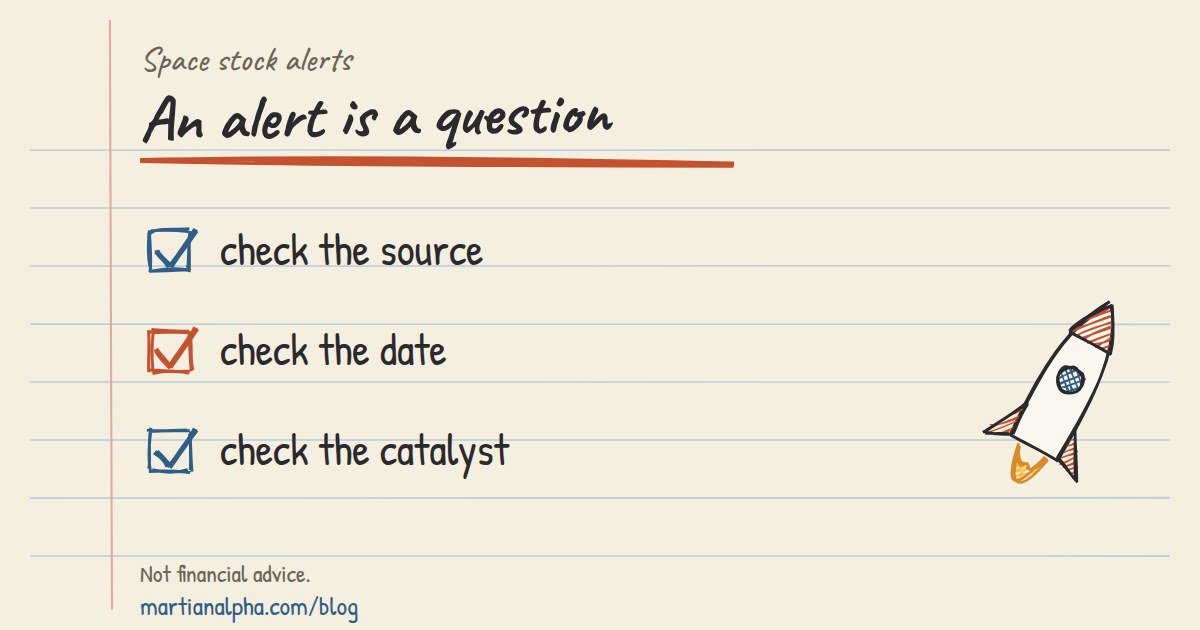
Good space stock alerts combine a price or volume trigger with the catalysts that actually move the sector: launches, contract awards, SEC filings and lock-up dates. Treat each alert as a prompt to check, not a signal to trade. When one fires, confirm the cause in a primary source (the 8-K, the Form 4, the launch result or the contract announcement) before reading anything into the move. As of October 13, 2026, Martian Alpha's free plan includes a watchlist with price and news alerts for up to 2 tickers, and paid plans raise the limit (plans page: /more-stuff).
Which alerts to set#
Space stocks move on ordinary market forces and on events specific to the sector. A useful alert list covers both:
| Alert type | What it catches | Notes for space stocks |
|---|---|---|
| Price level | Breaks of support, resistance, 52-week highs or lows | Small caps can swing 10% in a session, so pair with a volume condition |
| Relative volume | Volume well above the stock's average | The simplest filter for separating real moves from noise |
| SEC filings | 8-Ks (material events), Form 4s (insider trades), S-1s and 424B prospectuses | Filing deadlines make the timing predictable (see below) |
| Launches | Launch dates, scrubs, results | Dates slip often; set alerts on the result, not just the date |
| Contract awards | Department of Defense, NASA and Space Force awards | DoD publicly announces contract actions over $9 million |
| Calendar events | Earnings dates, lock-up expiries, index changes | Known in advance, so they belong on a calendar, not in a scanner |
Filing deadlines that set alert timing#
Several space-stock catalysts arrive on a predictable clock, which tells you how quickly news should show up after an event:
- Form 8-K: four business days. Companies generally must file within four business days of a material event, such as a new contract or a termination (SEC Form 8-K guidance). A press release can come first; the 8-K is the version with legal weight.
- Form 4: two business days. Directors, officers and 10% holders report trades within two business days. Most Form 4s at space companies are planned sales or tax withholding rather than purchases; our guide to reading Form 4 insider trades explains the transaction codes.
- DoD contract announcements. Under DFARS 205.303, the Department of Defense publicly announces contract actions with a face value above $9 million, in its daily contracts list. Smaller awards appear later in federal spending data.
- Earnings and lock-ups. These are scheduled. SpaceX (SPCX), for example, began trading on June 12, 2026 and reported its first quarterly results on August 4, and the first release of locked-up shares followed two trading days later, as set out in its final prospectus. Its third-quarter results came on October 20, 2026 (after the close), and the next large lock-up release followed on October 22, the second full trading day after.
How to set up an alert#
Most platforms ask for the same fields, whether it's a charting tool, a broker app or a scanner:
- Condition: a price crossing a level, a percentage move, or an indicator threshold.
- Second condition, where allowed: for example, volume above twice its 20-day average.
- Frequency: "once" or "once per bar close", so a volatile stock doesn't send ten notifications in a minute.
- Expiry: an end date, or open-ended for a long-term level.
- Channel: push notifications for time-sensitive alerts, email for anything that can wait until the end of the day.
- Test it: set a tight threshold first to confirm delivery, then move it to the real level.
Keep the number of push alerts small. If your phone buzzes for every 3% move, you'll stop reading them, and you'll miss the one that matters.
Thresholds for volatile space stocks#
A fixed price alert works for a large, steady stock. For a small-cap launch or satellite company, it either fires on routine noise or misses the move. Three adjustments help:
- Require volume. A price break on relative volume of 2x or more is more likely to reflect real buying or selling than one on thin trading.
- Compare with the group. If every space stock is up 6%, the alert probably reflects a sector-wide move, not company news. Coverage of the SpaceX IPO noted spillover moves across aerospace shares that had nothing to do with those companies' own businesses.
- Watch the clock. Many space catalysts land outside market hours: launches at night, 8-Ks after the close, contract lists late in the day. Expect gaps at the open rather than intraday moves.
The 8-step check when an alert fires#
- Find the cause. Look for a filing, a launch result, a contract award or a news item from the last 24 hours.
- Read the primary source. Open the 8-K, Form 4, launch provider's update or contract announcement rather than relying on a headline.
- Check volume. Compare with the stock's average to rule out a thin-market move.
- Check the sector. Compare with other space stocks and the broad market.
- Check the calendar. Is an earnings date, lock-up release or launch coming up that explains positioning?
- Check the size. A $10 million contract matters to a company with $50 million of revenue, much less to one with $5 billion.
- Decide: keep watching, dismiss, or do more research. An alert is never a reason on its own.
- Write it down. A short log of which alerts led to real news and which were noise is what improves your thresholds over time.
How Martian Alpha handles alerts#
Martian Alpha is a research terminal for public space companies. Its alerts are built around the watchlist:
- Price alerts email you when a watchlist stock crosses the level you set.
- News alerts email new items from the Catalyst Feed for your watchlist tickers, each tagged with a catalyst type (earnings, contract award, launch, regulatory filing, insider trade and others) and a bullish, bearish or neutral impact.
- The launch calendar shows scheduled missions linked to the public companies involved, so you can see when a launch-related alert is likely.
- The CANSLIM screener narrows the list of stocks worth watching in the first place.
The watchlist with price and news alerts is free for up to 2 tickers; paid plans add more tickers and higher AI limits (see the plans page for current pricing). For how launch dates and 8-Ks fit together, see our rocket launch calendar guide for investors.
This guide describes how to set up and check alerts. It isn't financial advice or a recommendation to buy or sell any security.
Related reading: Space Stock Backlog Compared: RKLB, LUNR, FLY, PL, RDW.
FAQ#
What should a space stock alert include?#
A price or percentage level, a volume condition, and a note of any scheduled catalyst nearby, such as a launch window, earnings date or lock-up release. Alerts tied to filings (8-Ks, Form 4s) and contract awards are often more useful than pure price alerts for small space companies.
How quickly do space companies have to disclose news?#
Material events generally go on Form 8-K within four business days, and insider trades on Form 4 within two business days. The Department of Defense publicly announces contract actions above $9 million.
Why do all space stocks move at once?#
They share catalysts and investors. A big event such as the SpaceX IPO in June 2026, a launch failure or a shift in risk appetite can move the whole group. Compare a stock's move with its peers before assuming it has company-specific news.
Should I trade automatically when an alert fires?#
An alert tells you something changed, not why. Check the primary source and the sector first; many alerts on small space stocks turn out to be noise or sector-wide moves.
Sources#
- SEC: Exchange Act Form 8-K compliance and disclosure interpretations
- SEC: Form 4 instructions and transaction codes
- DFARS 205.303, Announcement of contract awards (acquisition.gov)
- SpaceX final prospectus (424B4), June 2026 and second-quarter 2026 results
- MarketScreener: SpaceX IPO buzz lifts aerospace shares on spillover bets
This article is for information only and is not financial advice. Do your own research before making any investment.