 Martian Alpha
 Rocket Launch Calendar for Investors: 8-Ks and FAA Mishaps
Use a rocket launch calendar that links launches to Form 8-K filings, FAA mishap status, and NASA contracts. Verify catalysts and time space-stock trades.
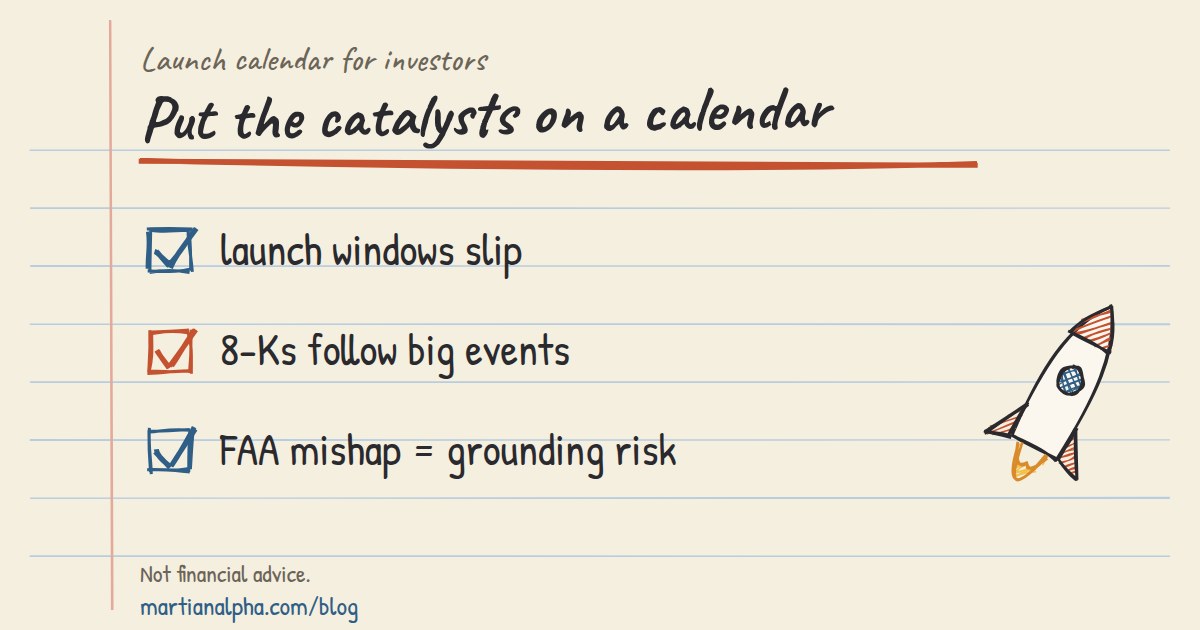
An investor-focused rocket launch calendar tracks mission dates for publicly traded space companies alongside the disclosures that make those dates matter: SEC filings, FAA regulatory status, and NASA contract backlog. Its job isn't to tell you when to watch a livestream. It's to help you time trades around a Form 8-K filing, flag an FAA mishap investigation before it tanks a stock, and confirm whether a launch is backed by durable contract revenue or just a one-off technical demo.
TL;DR:
- Most launch dates become actionable only when linked to specific SEC filings, regulatory statuses, or government contracts that impact a company's financial outlook.
- An FAA mishap investigation can delay launches for months, with the investigation's complexity affecting the duration more than the initial incident.
- Confirming a contract-backed mission requires a recent Form 8-K disclosure and a clean regulatory record to distinguish it from speculative or failed test flights.
- Relying solely on launch dates without verifying filings or regulatory updates increases trading risk, especially when mishaps or contract issues are involved.
- Using an integrated platform that combines launch schedules, filings, and regulatory information speeds up research and improves reaction times for event-driven trading.
What Belongs on an Investor-Focused Rocket Launch Calendar?#
A calendar entry that only lists a date and a rocket name is close to useless for trading purposes. What separates a research-grade calendar from a public viewing schedule is the layer of financial and regulatory context attached to each mission.
Every entry investors track should include:
- Mission identifier and vehicle, plus the customer and contract type, whether it's a commercial payload or a task order under a program like NASA's VADR contract or NLS II.
- Planned launch window versus firm date, with a slip history, since a mission that has already moved three times behaves differently in a model than one holding its original date.
- Regulatory triggers, including any FAA mishap status or pending license modification tied to the vehicle or launch site.
- Related SEC filings, especially Form 8-K Items 1.01, 1.02, or 1.05, which cover material agreements, terminations, and cybersecurity incidents.
- Reliability metrics, such as the operator's historical cadence and success rate on the same vehicle class (our launch vehicle comparison puts payload, price and status side by side).
The StarBurst gamma-ray detector mission is a useful template. NASA's award notice specifies a firm-fixed-price task order under VADR, with the launch listed as no earlier than 2028. That single detail tells you the mission is contract-backed rather than speculative, and it gives you a concrete date to anchor a multi-year model.
How Do Investors Turn Launches Into Trading Signals?#
Not every launch moves a stock the same way. The distinction that matters most is whether a mission is a one-off technical test or the operational proof of an existing revenue contract.
A test flight failure on an experimental vehicle often produces a short volatility spike that fades once the company issues a technical update. A failure on a contract-backed mission, tied to a customer named in a Form 8-K, tends to hit both the near-term revenue outlook and the stock's valuation multiple, because analysts start questioning execution risk on the entire backlog.
Three checks turn a calendar date into an actual signal:
- Check the filing trail first. A Form 8-K disclosing a new agreement (Item 1.01) ahead of a launch is a stronger revenue signal than a press release alone, since SEC rules require companies to file within four business days of the triggering event.
- Weigh mishap classification carefully. An FAA-designated mishap triggers a mandatory investigation that can run from a few weeks to several months, and launches typically stay grounded until corrective actions are approved.
- Stack signals before sizing a trade. A launch that combines a contract-backed customer, a clean regulatory history, and a Form 8-K confirming the agreement carries more weight than any single data point.
Pro Tip: Treat an FAA mishap notice as a timeline problem, not a binary pass/fail. The operator-reliant investigation process can move quickly for minor anomalies but drag for months on complex failures, so your position sizing should reflect that uncertainty window, not just the headline event.
The most reliable setups combine a scheduled launch, a confirmed contract in EDGAR, and a clean regulatory record. The riskiest ones are launches with no visible 8-K trail and a vehicle that has an open mishap investigation from a prior flight.
Where Should Investors Verify Launch Calendar Data?#
Every date on a launch calendar is only as good as its source. Cross-referencing primary government and corporate filings before acting on a calendar entry separates disciplined investors from people trading off secondhand headlines.
The core sources worth bookmarking:
- SEC EDGAR for the actual Form 8-K text, not a summary; companies generally have four business days to file after a material event, though delay provisions for cybersecurity incidents can extend that window.
- The FAA's compliance and mishap page, which tracks open investigations and license modifications tied to specific launch sites and vehicles.
- NASA and other agency press pages, which confirm task orders under programs like VADR and NLS II, giving you primary evidence of backlog rather than relying on a company's own characterization.
- The company's own 8-K and press release archive, cross-checked against the agency announcement for consistency.
A four-business-day filing window is the single number worth memorizing: it's the standard clock the SEC applies to most material 8-K events, confirmed by Investor on current reports. When a company misses that window without a documented delay reason, treat it as a research flag, not an oversight.
Note the EDGAR accession number and take a timestamped screenshot when you pull a filing. Launch schedules get revised, press pages get updated, and having your own dated record of what a filing said on a given day protects you when a narrative shifts later.
How Do You Build a Launch Calendar Into a Trading Workflow?#
A calendar only pays off if it feeds into alerts and screens you actually check. Manually refreshing five government websites before every trade doesn't scale.
- Set up automated alerts on EDGAR filings, FAA mishap notices, and NASA contract award pages, layered on top of your calendar entries for upcoming missions.
- Pair each launch with a screener filter for backlog size, contract type, and liquidity, so you're not trading a contract-backed mission with the same assumptions as a speculative test flight.
- Backtest simple event windows, like price behavior in the three days before and after a scheduled launch, to see whether your specific universe of stocks actually reacts to date proximity.
- Apply fixed position-sizing and stop rules for event-driven trades, since regulatory delays can extend a "catalyst" window well past your original thesis.
Pro Tip: Log every launch-driven trade with the filing date, the 8-K item number, and the outcome. After a dozen trades, you'll usually see which signal combinations actually predicted price movement for your specific sector focus, and which ones were just noise.
Why a Space-Focused Terminal Cuts the Verification Time#
Pulling launch dates from one site, 8-K filings from EDGAR, and mishap status from the FAA separately is slow, and slow research misses fast-moving catalysts. Some platforms combine a launch and catalyst calendar with automated alerts, a CANSLIM screener, and AI-powered company analysis in one terminal, so a contract award or filing update surfaces without three separate browser tabs.
The platform's macroeconomic briefing system adds context around broader market moves, while the community feed shows what other space-sector investors are flagging. For investors following several space stocks, having launches, catalysts and filings in one place makes it less likely that a filing goes unnoticed for days.
What Investors Get Wrong About Launch Dates#
The most common mistake is treating a single launch as the whole thesis. A rocket sitting on a pad is a data point, not a catalyst, until it's connected to a filing, a contract, or a regulatory record that changes the financial picture.
The second mistake is ignoring context on an FAA mishap. Investors either panic-sell on the word "mishap" or ignore it entirely, when the real question is how long the investigation and stand-down is likely to run based on the complexity of the failure.
The discipline that actually works: pair every launch date with its filing evidence, define an event window instead of trading on the date alone, and size positions for the regulatory uncertainty, not just the technical outcome. One takeaway to keep: the date tells you when, the filings tell you why it matters.
Track Launches, Filings, and Contracts in One Place#
Certain terminals are designed specifically for investors who treat launch dates as evidence, not headlines. Instead of switching between EDGAR, the FAA's mishap page, and a company's press releases, users get a launch calendar, watchlist price and news alerts, a catalyst feed that includes regulatory filings, a CANSLIM screener, and AI-generated company analysis inside one terminal built around publicly traded space companies.
The workflow described throughout this guide, alerts feeding into screening, screening feeding into a trade decision, maps directly onto Martian Alpha's feature set. Core research tools, including the launch calendar, remain free to use. Paid plans add deeper datasets and power-user tools; see the plans page for what each tier includes. Check the full plan breakdown and start with the free tier to see how the calendar and alerts fit your current watchlist.
Sources#
Keep SEC EDGAR's Form 8-K guidance, the FAA's mishap and compliance page, and NASA's contract award release archive on hand. Each confirms a different layer of a calendar entry: the filing, the regulatory status, and the backlog.
- SEC | Exchange Act Form 8-K (staff guidance)
- FAA — Compliance, enforcement and mishap information for commercial space
- NASA news release — NASA awards launch services for StarBurst gamma-ray detector
- Government Accountability Office — report on commercial space oversight
FAQ#
What Is an Investor-Focused Rocket Launch Calendar?#
It's a calendar that tracks scheduled rocket missions for publicly traded space companies alongside the SEC filings, FAA regulatory status, and government contracts tied to each launch. It's built for timing trades and monitoring risk, not for viewing logistics.
How Fast Must Companies Disclose Material Launch Events?#
Companies generally must file a Form 8-K within four business days of a material event, such as a new launch contract or a termination. Delay provisions exist for specific cases like cybersecurity incidents.
What Does an FAA Mishap Investigation Mean for a Stock?#
An FAA-designated mishap triggers a mandatory investigation that can run from a few weeks to several months, during which launches on that vehicle are typically grounded. That uncertainty window is often the real driver of stock volatility, not the initial incident itself.
Why Do NASA Contracts Like VADR and NLS II Matter to Investors?#
Programs like VADR and NLS II are multi-award, task-order contracts that create recurring backlog rather than one-time revenue. NASA's addition of Relativity Space's Terran R to NLS II on September 9, 2026, through the contract's on-ramp provision, shows how on-ramps expand a provider's addressable backlog over time.
Does Martian Alpha Include a Launch Calendar for Free?#
Yes, core research tools including the launch calendar are available on Martian Alpha's free tier. Paid plans add higher limits and power-user tools.
This article is for information only and is not financial advice. Do your own research before making any investment.