 Martian Alpha
 Comparing Launch Vehicles: Specs and Investor Checklist
Primary source specs and mission-fit checks to shortlist launch vehicles. Includes an investor checklist, sourcing notes, and Martian Alpha market signals.
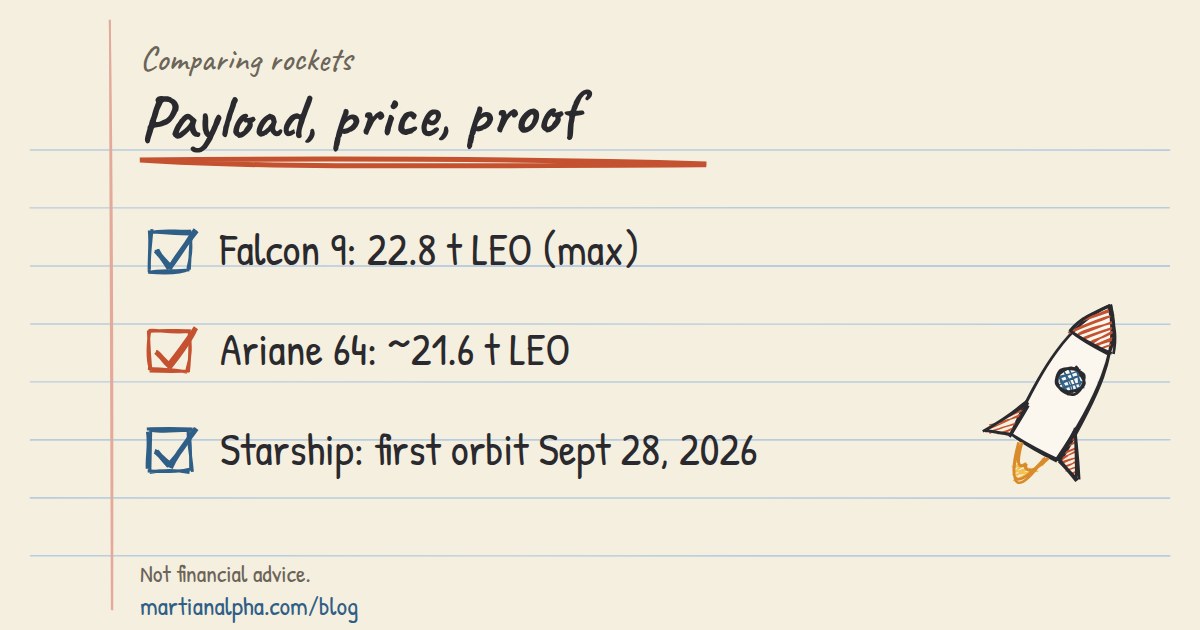
This comparison sets current and near-term orbital launch vehicles side by side on payload, reusability, cost, and flight heritage so you can shortlist by mission class. Small-lift vehicles suit dedicated smallsat and rideshare work, medium-lift covers most commercial GTO and constellation launches, heavy-lift and super-heavy vehicles serve large comsats, deep-space missions, and crewed programs. The deciding metrics are payload by orbit, reusable versus expendable configuration, and demonstrated flight history, all detailed in the table below.
TL;DR:
- Reusable vehicles like Falcon 9 reduce payload capacity at orbit due to fuel reserved for recovery, impacting cost and performance trade-offs.
- Payload figures must be paired with specific orbit and configuration labels since different mission profiles cause large capacity variations.
- Flight heritage reliability depends on the number of launches and hardware consistency, making recent demonstrated success more meaningful.
- New vehicles, such as Starship (first orbital flight September 28, 2026), remain uncertain until they build a consistent operational record, which adds schedule risk.
- Market dynamics favor configuration-focused comparisons over headline payload numbers, emphasizing verification of mission-specific, documented performance data.
Side-by-Side Specs: Comparing Rocket Types Across Classes#
A spec table only works when every figure is anchored to a stated configuration, since payload numbers shift meaningfully between expendable and reusable flights. Analysts and investors comparing Falcon 9 vs Ariane 6 or evaluating market entrants should treat the table as a starting shortlist, not a final verdict; mission-specific verification with the operator's user guide remains necessary before contracting.
| Vehicle | Operator | LEO payload | GTO payload | Reusability | Status (Oct 2026) | Published price | Source |
|---|---|---|---|---|---|---|---|
| Falcon 9 | SpaceX (US) | 22,800 kg (maximum, expendable) | 8,300 kg (maximum, expendable); the standard price covers up to 5.5 t to GTO | First stage and fairings reused | Operational, flies most weeks | $69.75M standard (SpaceX's 2024 price list) | Falcon 9 page, Capabilities & Services |
| Ariane 62 | Arianespace / ESA (Europe) | ~10.3 t | ~4.5 t | Expendable | Operational since 2024 | Not published | ESA Ariane 6 overview |
| Ariane 64 | Arianespace / ESA (Europe) | ~21.6 t | ~11.5 t | Expendable | First four-booster flight in February 2026 | Not published | ESA Ariane 6 overview |
| SLS Block 1 | NASA (US) | Not marketed for LEO | More than 27 t to the Moon (trans-lunar injection) | Expendable | Flew Artemis I (Nov 2022); dedicated to Artemis | Not a commercial vehicle | NASA SLS reference |
| Starship | SpaceX (US) | Not yet published as a firm figure | Not yet offered | Both stages designed for reuse | First orbital flight Sept 28, 2026 (Flight 14) deployed 26 Starlink V3 satellites | Not published | SpaceX Flight 14 |
According to the NASA SLS reference guide, SLS Block 1 can send more than 27 metric tons to the Moon and generates about 8.8 million pounds of thrust at liftoff, figures that place it among the highest-capacity operational vehicles anywhere. That capacity comes at the cost of full expendability, a tradeoff that keeps per-flight cost structurally higher than vehicles built for stage recovery. A second pattern worth flagging: Falcon 9's published price band applies to its reusable configuration, and the expendable variant, reserved for the heaviest single payloads, carries a different and higher cost basis that the same headline figure does not capture. Third, Ariane 6 remains fully expendable by design, a choice explored further below, which separates its market position from purely commercial payload-per-dollar competition.
Reusable recovery typically reduces payload to orbit compared with the same vehicle flown expendable, according to technical notes on Falcon 9 explaining that recovery fuel margins cut into usable payload mass. That single fact explains much of the spread in any table that mixes reusable and expendable figures without labeling them.
How to Read Payload, Reliability, and Cost Figures#
A payload number only means something once you know which orbit and which configuration produced it. LEO, GTO, and translunar injection (TLI) figures are not interchangeable: a vehicle's LEO capacity can be several times its GTO capacity because reaching geostationary transfer orbit demands far more delta-v from the upper stage. Comparing a LEO number for one rocket against a GTO number for another produces a meaningless ranking, yet that mismatch shows up often in casual "best rocket" lists.
Reusable and expendable payload figures for the same vehicle diverge for a specific reason: recovering a first stage requires reserving propellant for boostback, reentry, and landing burns, mass and fuel that would otherwise go toward payload. Catalog notes on Falcon 9 confirm this tradeoff directly, which is why any serious comparison marks each payload figure as reusable or expendable rather than reporting a single blended number.
Published per-launch price is a list price, not a mission cost. Real mission economics add integration work, insurance, manifest position, and schedule risk, and none of those show up in a headline dollar figure. A mission-first comparison framework makes the same point: payload-to-orbit and configuration matter more than any single price line, because the vehicle has to match the mission architecture before cost comparisons are useful at all.
Reliability metrics carry their own sample-size problem. A vehicle with 10 flights and zero failures has a different statistical confidence than one with 300 flights and a handful of anomalies, even if both report similar percentage success rates. Consider these factors when reading a flight-heritage number:
- A small flight count can produce a misleadingly clean success rate simply because there have not been enough launches to reveal rare failure modes.
- Partial failures, where a payload reaches the wrong orbit rather than being lost outright, are sometimes excluded from headline success percentages.
- Vehicle blocks and hardware revisions reset some of the accumulated heritage, since a Block 5 Falcon 9 is not identical to earlier iterations.
Fairing volume and payload interface standards matter as much as raw mass capacity for many missions. A satellite that fits the mass budget but not the fairing diameter cannot fly on that vehicle regardless of what the payload table says, which is why mission planners check fairing dimensions and adapter standards before shortlisting on payload mass alone.
Pro Tip: Always pair a payload figure with its orbit and configuration label before comparing it across vehicles; an unlabeled number is not comparable to anything.
Operational Launch Vehicles by Class and Mission Fit#
Operational vehicles split cleanly by lift class, and each class serves a distinct mission profile rather than competing head to head across the board.
- Small-lift vehicles serve dedicated smallsat missions and niche orbits where rideshare timing does not fit a customer's schedule, trading higher cost per kilogram for launch date control. For how cost per kilogram has fallen over six decades, see launch cost trends.
- Medium-lift vehicles, led by Falcon 9 in its various configurations, cover the bulk of commercial GTO comsat launches, constellation deployment, and government rideshare missions, benefiting from the highest flight cadence among orbital vehicles.
- Heavy-lift vehicles handle larger single-payload GTO missions and some interplanetary launches where medium-lift capacity falls short, typically at expendable configuration for maximum mass delivery.
- Super-heavy vehicles, exemplified by SLS, exist for crewed deep-space missions and the largest institutional payloads, where per-flight cost is secondary to raw capacity and mission assurance.
Rideshare missions gravitate toward medium-lift vehicles with frequent manifest slots, since a rideshare customer is buying a fraction of a launch and needs predictable cadence more than maximum single-payload capacity. Dedicated smallsat missions instead favor small-lift vehicles precisely because they buy schedule certainty. GTO comsat operators weigh medium-lift and heavy-lift options against their specific mass and orbit requirements, often choosing based on which configuration, reusable or expendable, clears their mass margin without unnecessary cost. Crewed and deep-space missions sit almost exclusively with super-heavy vehicles built to institutional reliability and mission-assurance standards rather than commercial price competition.
Scheduling realities matter as much as specs. Manifest windows for medium-lift vehicles with high cadence can open months ahead, while heavy-lift and super-heavy vehicles often carry lead times measured in years given their lower flight frequency and the institutional review processes attached to their payloads. Booking early and confirming interface commitments in writing avoids the most common planning failure: a payload ready for flight with no confirmed slot to fly on.
Rockets in Flight Testing: Reading Unproven Vehicles Correctly#
Vehicles still in flight testing publish design-target figures that have not yet been demonstrated across a meaningful flight history, and treating those numbers as settled specs is the most common mistake in early-stage comparisons.
- Starship reached orbit for the first time in September 2026 and carried 26 Starlink V3 satellites, but its often-quoted capacity of more than 100 metric tons to LEO in a fully reusable configuration is still a design target rather than a demonstrated result.
- Flight-testing vehicles often change configuration between launches, meaning a failure or partial success on one flight may say little about the next flight's hardware.
- Evolving flight software and vehicle "blocks" during a testing campaign mean early flight data does not necessarily predict later reliability.
- A partial success, where some mission objectives are met and others are not, should be read as a data point about that specific test, not as a verdict on the design's final performance.
The practical guidance for near-term planning is straightforward: treat in-testing vehicles as unavailable for mission-critical manifests until they accumulate a flight history with consistent hardware configuration. Investors and analysts watching these programs should track test cadence and the nature of any anomalies rather than headline payload claims, since the gap between a design target and a demonstrated capability is exactly where schedule risk and cost overruns tend to concentrate.
Upcoming Rockets and Their Likely Market Impact#
Several development-stage entrants aim to shift either cost or capacity baselines once they reach operational status, though each carries meaningful timeline risk before that happens.
- Vehicles targeting full first-and-second-stage reusability, following the pattern Starship is testing, would pressure medium and heavy-lift pricing if they reach operational cadence.
- Higher-lift entrants aimed at institutional and national-security payloads would compete most directly with existing heavy-lift and super-heavy capacity rather than with commercial medium-lift vehicles.
- Rideshare-focused new entrants would affect small-lift pricing most, since that segment already competes heavily on schedule flexibility rather than raw capacity.
The market's baseline already shifted once demonstrated reusability on Falcon 9 lowered marginal launch costs, and observations on Starship's market position note that new entrants now need to show either a cost advantage or a capability advantage to compete, not simply matching existing specs. For analysts, the signal worth tracking is not the announced timeline, which development programs routinely miss, but the pace of flight-test milestones and any contract awards that follow a vehicle's move from testing to operational status. A single successful flight rarely changes a market; a string of consistent flights with stable hardware configuration usually does.
How to Choose a Launch Vehicle for Your Mission#
Selecting a vehicle is a process of narrowing, not picking a single "best" rocket from a ranked list.
- Define the mission orbit and constraints first, including payload mass, volume, and any injection accuracy requirements the satellite bus demands.
- Shortlist by raw payload and fairing volume for that specific orbit, then check whether the vehicle's reusable configuration still clears your mass margin or whether you need the expendable variant.
- Weigh operational risk factors, including flight cadence, typical booking lead time, integration costs, insurance requirements, and contingency plans if a slot slips.
- Select a primary and a backup vehicle, and document manifest commitments and payload interface requirements in writing before finalizing a contract.
- Resolve open questions with the vendor before signing, including which payload figure (reusable or expendable) applies to your specific mission and what happens if the vehicle's configuration changes before your launch date.
Red flags worth resolving early include a published payload figure with no stated configuration, a manifest slot with no documented interface agreement, and a vehicle still in flight testing being offered for a schedule-sensitive mission. A mission-first comparison approach argues that matching mission architecture to vehicle capability beats chasing a headline ranking, and that holds just as well for a procurement decision as for a desk comparison.
Pro Tip: Ask every shortlisted vendor for the specific payload figure tied to your mission's orbit and configuration in writing, not the general marketing number from their public spec sheet.
How This Comparison's Numbers Were Sourced#
Figures in this comparison come first from agency and manufacturer primary sources, including NASA reference documents and manufacturer specification pages, with industry reporting used for policy context and pricing discussion where primary figures are not published.
- Primary-source specification documents were preferred over aggregator or directory figures wherever both existed.
- Fields marked "configuration dependent" indicate the manufacturer publishes multiple figures based on variant or mission profile rather than a single number.
- Fields left unpublished in this comparison indicate no primary-source figure was available at the time of research, not that the figure does not exist.
- Readers making mission-critical decisions should check current manufacturer user guides and live manifest data directly, since specifications and pricing can change between vehicle blocks.
Martian Alpha Perspective: Market Signals Behind the Specs#
Reusability's effect on launch economics extends past the headline price cut: it changes margin structure, since a recovered booster converts a expendable capital cost into a reusable asset amortized across many flights. That shift is the core reason reusable vehicles have compressed pricing in the segments where they compete.
Sovereign programs like Ariane 6 persist despite that pressure because European policy prioritizes guaranteed access to space over pure commercial cost competition, a distinction that matters for contract stability: government-backed manifests tend to be less price-sensitive and more schedule-guaranteed than commercial launch contracts.
For investors tracking these dynamics, technical differences between vehicles translate directly into market signals: a reusability milestone, a new contract award, or a reliability track record shift ahead of a competitive bid. Launch calendars, rocket reliability metrics, and equity screeners help track catalysts and the public companies behind space hardware.
Environmental Considerations in Launch Vehicle Design#
Launch vehicles vary in their sustainability profile depending on propellant choice, reusability, and launch cadence. Reusable first stages reduce the manufacturing footprint per flight by amortizing hardware across multiple launches instead of discarding a full stage each time, one of the clearer sustainability arguments in favor of reusable designs over expendable ones. Propellant choice also matters: some vehicles use kerosene-based fuels, others use hydrogen or methane, and each carries different combustion byproducts and supply-chain considerations.
Launch cadence itself raises separate questions as commercial flight rates climb, including atmospheric effects from more frequent launches and reentry debris from expended stages or fairings that are not recovered. Expendable upper stages and discarded hardware also contribute to orbital debris accumulation, a concern that grows as more operators compete for similar orbital slots. None of these factors currently appear as standardized figures across manufacturer spec sheets, so readers evaluating a vehicle's environmental profile should treat it as a qualitative factor alongside payload and cost rather than expecting a single comparable metric.
The Launch Vehicle Development Timeline#
A new launch vehicle typically moves through design, component testing, integrated ground testing, and flight testing before reaching operational status, a process that commonly spans many years from initial design commitment to first operational flight. Early design work establishes performance targets for payload, thrust, and reusability, targets that often shift as engineering constraints surface during development.
Flight testing, the stage several current entrants occupy, is where design targets meet demonstrated performance, and it is also where schedules most often slip, since anomalies during test flights routinely push timelines well past initial announcements. A vehicle only earns "operational" status once it accumulates a flight history sufficient for its operator and customers to trust its published figures for mission-critical payloads, a threshold that varies by customer risk tolerance rather than a fixed flight count. Vehicles that survive this process and reach steady cadence, like Falcon 9, represent a small fraction of announced programs, which is part of why flight-testing entrants deserve the caution outlined earlier in this comparison.
Manufacturers and Operators: Market Access by Country#
Launch vehicle access concentrates around a small number of countries and companies, each with a different mix of commercial and government-directed capacity. The United States hosts the highest flight cadence globally, led by SpaceX's Falcon 9 operations alongside government programs like NASA's SLS. Europe maintains independent access through ArianeGroup's Ariane 6, a program tied to sovereign policy objectives rather than commercial market share alone, which keeps it operating even where its per-launch pricing may not compete directly with reusable alternatives.
Market access for a given customer depends heavily on nationality and payload sensitivity as much as on price or capacity. Government and defense payloads often face restrictions steering them toward domestic or allied launch providers regardless of cost, while commercial comsat and constellation operators generally have more flexibility to select across providers on payload fit and schedule. This dynamic means market share figures for launch vehicles reflect policy access as much as competitive performance, a distinction worth remembering before drawing conclusions from cadence numbers alone.
What This Comparison Should Change About How You Shortlist#
The conventional approach to launch vehicle comparisons still leans on headline payload numbers and "best rocket" rankings, and that habit misleads more often than it helps. The evidence here points to a different priority order: configuration label first, orbit match second, flight heritage third, and price last, because price without the first three is not comparable to anything.
The most overrated input in casual comparisons is a single maximum-payload figure pulled from a press release. It is almost always an expendable, best-case number that will not apply to the mission most readers are actually planning. The most underrated input is flight heritage broken down by hardware block, since a vehicle's aggregate success rate can hide a cleaner recent record or a recurring issue tied to an older configuration.
If you take one habit from this comparison, verify which configuration produced any number before you act on it, whether you are planning a mission or reading a company's launch backlog as an investment signal. That single check separates a useful comparison from a misleading one.
Track These Market Shifts With Martian Alpha#
Technical differences between launch vehicles show up in the market long before most retail investors notice them, and Martian Alpha's launch calendar tracks upcoming launches, contract awards, and reliability metrics for the public companies behind this hardware, alongside the CANSLIM screener for identifying setups in the space sector.
| Tool | What it tracks |
|---|---|
| Launch calendar | Upcoming launches and manifest windows across operators |
| Rocket reliability metrics | Flight history and success-rate context by vehicle |
| CANSLIM screener | Equity setups among publicly traded space companies |
Martian Alpha is a research terminal for investors, not a launch provider, built to help you follow the catalysts behind the vehicles compared here.
Core research tools remain free, with deeper data and power-user features available on the Space Enthusiast, Space Professional, and other paid plans.
Sources#
- Defense News — Europe’s Ariane 6 and sovereign access
- NASA SLS reference guide (PDF)
- Sentinel Mission — How to compare rocket types
FAQ#
What Are the Different Types of Launch Vehicles?#
Launch vehicles are generally grouped by lift class: small-lift for dedicated smallsat missions, medium-lift for most commercial GTO and constellation launches, and heavy-lift or super-heavy for the largest single payloads and crewed deep-space missions. Vehicles within each class also split between reusable and expendable configurations, which affects both payload capacity and cost.
Is Falcon 9 More Reliable Than Soyuz?#
This comparison's sources do not provide a direct, current side-by-side reliability figure for Falcon 9 against Soyuz, so a definitive answer is not supported here. What is well documented is that reliability comparisons require matching flight counts and hardware blocks rather than comparing lifetime aggregate rates, since reusable configuration changes the underlying hardware between flights in ways that affect how heritage should be read.
What Rocket Does SpaceX Use for Most Missions?#
SpaceX flies Falcon 9 for the large majority of its commercial and government missions, using the reusable first-stage configuration for most flights and reserving the expendable variant for the heaviest single payloads. Starship reached orbit for the first time on its 14th flight on September 28, 2026, deploying 26 Starlink V3 satellites, but it isn't yet flying commercial customer payloads.
Is SLS More Powerful Than Saturn V?#
This comparison's sources cover NASA's SLS Block 1 specifications directly, confirming about 8.8 million pounds (39,144 kilonewtons) of maximum thrust and more than 27 metric tons to the Moon for Block 1, but do not include a sourced Saturn V figure for direct comparison here. A reliable side-by-side on that question requires checking NASA's own historical Saturn V documentation alongside the SLS reference guide used in this comparison.
This article is for information only and is not financial advice. Do your own research before making any investment.