 Martian Alpha
 Launch Success Rates: How to Compare Rockets Fairly
Why a 1-for-1 rocket isn't 100% reliable, why trackers disagree on launch counts, and how to compare Falcon 9, Electron and new rockets on equal terms.
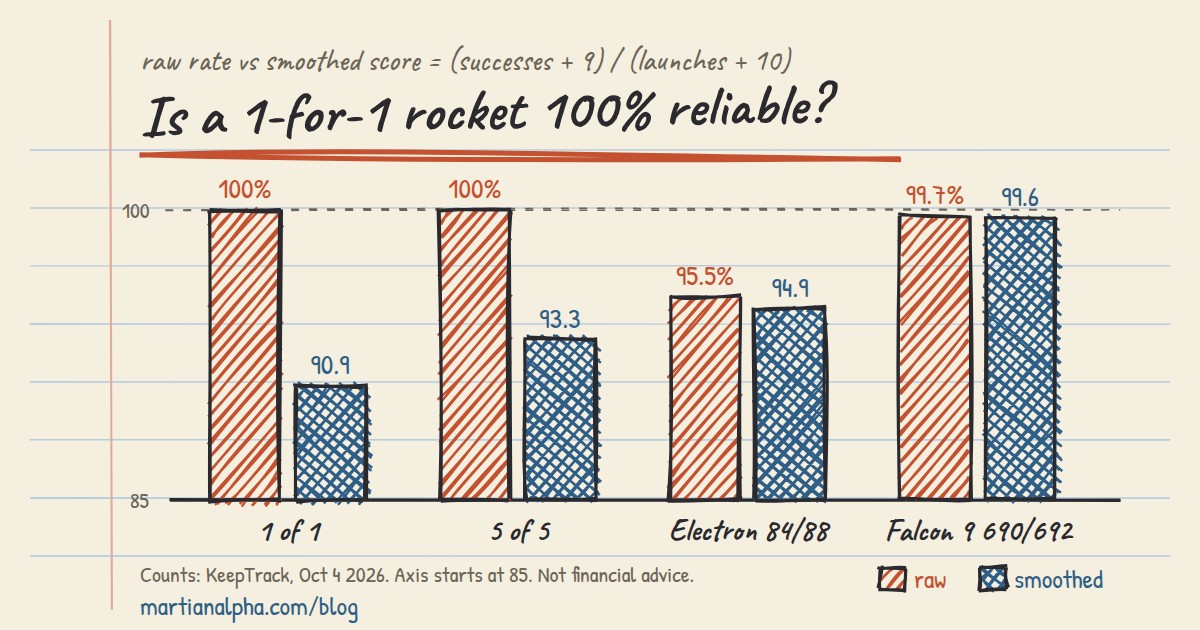
A rocket's launch success rate is successes divided by attempts, but that raw number is misleading when a rocket has flown only a few times: one good flight gives "100%". To compare rockets fairly, check how many flights the rate is based on, what the tracker counts as a failure, and use a smoothed rate that pulls small samples toward the industry norm. On that basis, Falcon 9's record (2 failures in about 690 attempts) and Electron's (4 in about 88) are both strong, and a new rocket with one success hasn't proved much yet.
Why the raw success rate misleads#
Launch records are small samples with rare failures, which is exactly the situation where simple percentages behave badly.
- One flight, one success, 100%. That tells you the rocket can work, not how often it will.
- Thirty flights with no failures still leaves room for doubt. The statistician's "rule of three" says that after n trials with zero failures, the true failure rate could plausibly be as high as about 3/n (an approximate 95% upper bound; Hanley and Lippman-Hand, JAMA, 1983). For 30 clean flights, that's up to about 10%.
- A whole-life rate mixes old and new. Problems are often found and fixed early in a rocket's life (Electron's first flight failed, for example), so a lifetime rate can understate how a mature rocket performs today, while a short record can overstate a new one.
Why two trackers give different numbers for the same rocket#
If you look up a rocket on two launch trackers, the totals often don't match. On October 4, 2026, KeepTrack listed 88 Electron launches with 84 successes and 4 failures, while Wikipedia's list of Electron launches counted 89 orbital launches with 85 successes and 4 failures, plus 9 suborbital HASTE flights kept separately. Neither is wrong; they differ on cut-off times and on what counts. The usual reasons:
| Counting question | Why it matters |
|---|---|
| Is a pad explosion a launch? | Falcon 9's AMOS-6 vehicle exploded during propellant loading before a static-fire test on September 1, 2016 (Spaceflight Now). Most trackers don't count it as a launch attempt, because the rocket never lifted off |
| Are suborbital variants included? | Rocket Lab's HASTE is an Electron derivative flown on suborbital tests; some sources fold it in, others list it separately |
| Partial failure or failure? | Launch Library 2 defines a partial failure as reaching orbit without delivering the payload to the targeted orbit, or an "exceptional event". Trackers decide case by case whether that counts against the rocket |
| Rocket or provider? | A provider-level rate mixes vehicles. SpaceX's provider number can include Starship test flights alongside Falcon 9 |
| What date is the snapshot? | Busy rockets fly weekly. Any number without a date is already stale |
So before comparing two rates, make sure they come from the same source, on the same date, with the same rules.
The failure record behind two well-known rockets#
Rates are easier to judge when you know what the failures were.
Falcon 9#
As of October 4, 2026, KeepTrack's Falcon 9 page lists 692 launch attempts with 2 failures:
- CRS-7, June 28, 2015. The rocket broke up during ascent on a cargo flight to the International Space Station. NASA's independent review traced it to a failed strut in the second-stage liquid-oxygen tank (NASA IRT public summary).
- Starlink Group 9-3, July 11, 2024 (02:35 UTC on July 12). A liquid-oxygen leak in the upper stage, from a cracked pressure-sensor line, left the satellites in too low an orbit. The FAA cleared Falcon 9 to fly again on July 25, 2024 (Reuters; Space.com).
Electron#
Rocket Lab's Electron has four orbital failures:
- "It's a Test", May 25, 2017, the first flight, terminated by range safety after a loss of telemetry. Rocket Lab's review found the rocket itself was flying normally and blamed misconfigured third-party ground equipment (Rocket Lab; SpaceNews).
- "Pics Or It Didn't Happen", July 4, 2020, the 13th mission, lost seven small satellites after the second-stage engine shut down early. Rocket Lab traced it to a faulty electrical connection (Spaceflight Now; Spaceflight Now on the cause).
- "Running Out Of Toes", May 15, 2021, a BlackSky mission lost after an anomaly at second-stage ignition (Rocket Lab).
- September 19, 2023, a Capella Space mission lost about two and a half minutes into flight (Rocket Lab release via Business Wire). Rocket Lab later attributed it to an electrical arc in the second stage's power system (Space.com).
Each failure was followed by an investigation, a fix and a return to flight. For a reader, the pattern matters as much as the count: failures of different causes spread over years suggest maturing hardware, while repeated failures from the same cause are a warning sign.
A fairer comparison: smoothing the rate#
A common fix for small samples is to add a few "pseudo-launches" at a typical industry success rate before dividing. That way, a rocket needs a real track record to score near 100%. Martian Alpha's Launch Reliability Scorecard does this with a 90% prior worth 10 launches:
Smoothed score = (successes + 9) ÷ (completed launches + 10)
Here's how that changes the picture:
| Record | Raw rate | Smoothed score |
|---|---|---|
| New rocket, 1 success in 1 | 100% | 90.9 |
| 5 successes in 5 | 100% | 93.3 |
| 19 successes in 20 | 95% | 93.3 |
| Electron, 84 of 88 (KeepTrack) | 95.5% | 94.9 |
| Electron, 85 of 89 (Wikipedia, orbital) | 95.5% | 94.9 |
| Falcon 9, 690 of 692 (KeepTrack) | 99.7% | 99.6 |
Three things stand out. A perfect 5-for-5 record scores the same as 19 successes in 20, because neither is yet much evidence. The two Electron counts give the same answer to one decimal place, so the tracker differences that look alarming barely matter once the sample is large. And Falcon 9's smoothed score hardly moves, because 692 attempts swamp the 10 pseudo-launches.
Smoothing isn't a prediction. It's a way of not over-reading short records. (The figures above are our own arithmetic on the cited counts as of October 4, 2026.)
How investors and customers use launch reliability#
- Satellite operators weigh reliability against price and schedule, and insurers price launch risk from the same records.
- Investors in launch companies watch for a return to flight after any failure, because a grounding pauses revenue. For a company with several vehicles, look at each rocket separately.
- Investors in satellite companies check which rockets carry their next deployment. A constellation that depends on an unproven vehicle carries schedule risk.
A simple checklist: note the number of flights, the date and source of the count, how partial failures are treated, whether the most recent flights were clean, and what the last failure's cause and fix were.
To see how the busiest launch providers compare today, the free Launch Reliability Scorecard shows success, failure and scheduled counts with the smoothed score for each provider, from Launch Library 2 data refreshed daily. It scores providers rather than individual rockets, and it covers the launches in Martian Alpha's tracked dataset (658 on October 4, 2026), a recent window rather than each rocket's full history, so its counts are smaller than the lifetime records above. The launch calendar lists upcoming missions, so you can see which rockets are about to add to their records. For upcoming missions in an investor context, see our rocket launch calendar guide for investors, and for payload, price and status side by side, comparing launch vehicles.
FAQ#
What is Falcon 9's launch success rate?#
As of October 4, 2026, KeepTrack lists 692 Falcon 9 launch attempts with 690 successes and 2 failures (CRS-7 in 2015 and Starlink Group 9-3 in 2024), a raw rate of about 99.7%. Counts vary slightly between trackers and change every week, so check the date of any figure you use.
How many times has Rocket Lab's Electron failed?#
Four orbital failures: May 2017, July 2020, May 2021 and September 2023. As of October 4, 2026, KeepTrack lists 88 Electron launches with 84 successes, and Wikipedia lists 89 orbital launches with 85 successes, plus suborbital HASTE flights counted separately.
Why is a rocket with a 100% success rate not always the most reliable?#
Because the rate may rest on very few flights. One success in one attempt is 100%, but it's weak evidence. A smoothed score, such as (successes + 9) ÷ (launches + 10), puts a 1-for-1 rocket at about 90.9 until it builds a longer record.
Do launch trackers count pad explosions as failures?#
Usually not, if the rocket never lifted off. Falcon 9's AMOS-6 explosion during propellant loading on September 1, 2016 is generally not counted as a launch attempt, but trackers set their own rules, which is one reason totals differ.
Is launch reliability a reason to buy a launch stock?#
No single metric is. This guide explains how to read success-rate data; it isn't investment advice or a recommendation to buy or sell any security.
Sources#
- Hanley JA, Lippman-Hand A. "If nothing goes wrong, is everything all right? Interpreting zero numerators." JAMA, 1983 (PubMed)
- Launch Library 2 launch status definitions (The Space Devs)
- KeepTrack: Falcon 9 launch history and Electron launch history (checked 2026-10-04)
- Wikipedia: List of Electron launches (checked 2026-10-04)
- NASA Independent Review Team, SpaceX CRS-7 accident investigation public summary
- Reuters: Falcon 9 cleared to return to flight, July 26, 2024 and Space.com: SpaceX finds cause of Falcon 9 failure
- Spaceflight Now: Falcon 9 explosion traced to upper-stage helium system (AMOS-6), Sept. 23, 2016
- Spaceflight Now: Rocket Lab launch fails before reaching orbit, July 4, 2020 and cause identified, July 31, 2020
- Rocket Lab: post-flight analysis of "It's a Test", 2017 and SpaceNews: telemetry glitch kept first Electron from reaching orbit
- Rocket Lab: anomaly during launch, May 2021
- Rocket Lab launch update, Sept. 19, 2023 (Business Wire) and Space.com on the cause
This article is for information only and is not financial advice. Do your own research before making any investment.