 Martian Alpha
 How to Read Form 4 Insider Trades at Space Companies
Form 4 codes explained with 2026 filings from AST SpaceMobile, Rocket Lab and Intuitive Machines: open-market buys, plan sales, exercises, tax, gifts.
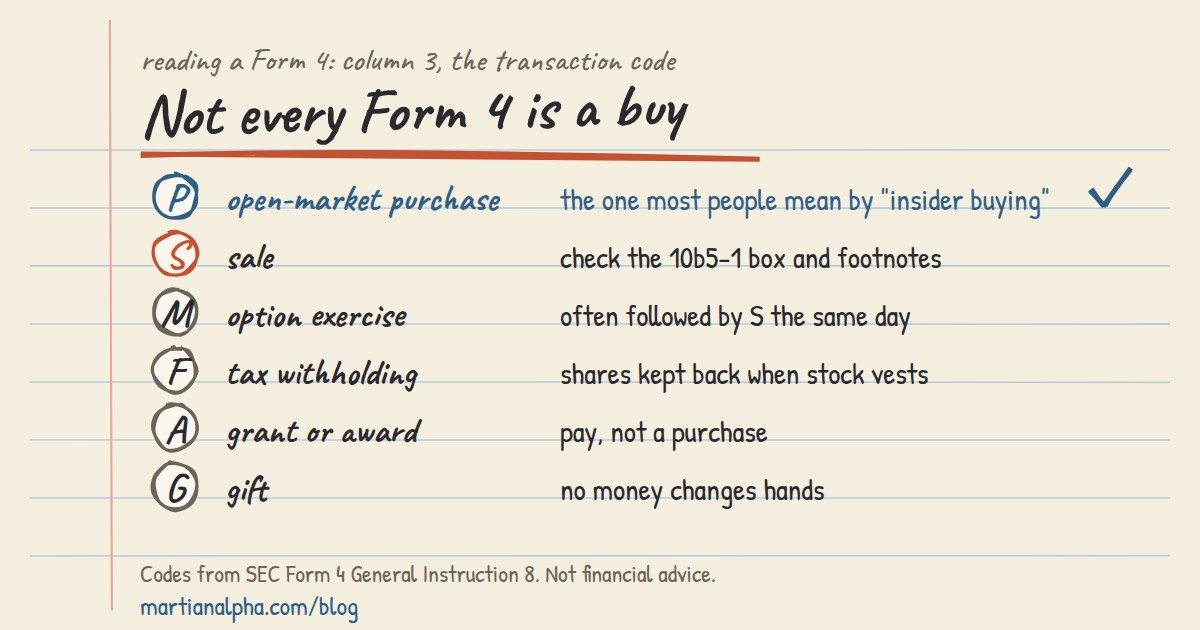
A Form 4 is the two-page SEC filing that a company's directors, officers and 10% owners must file within two business days of trading its stock. To read one, go straight to the transaction code in column 3 of Table I: only code P is an open-market or private purchase. Most Form 4s at space companies report something else, such as pre-planned sales (S), option exercises (M), shares withheld for tax (F), stock grants (A) or gifts (G), and none of those tells you that an insider chose to put new money into the stock.
Who files a Form 4, and how fast#
Section 16 of the Securities Exchange Act covers three groups at every US-listed company: directors, officers, and anyone who owns more than 10% of a class of its registered stock. When one of them buys, sells, exercises, receives or gives away company stock, the change goes on a Form 4.
The deadline is short. Under Rule 16a-3(g)(1), the form is due before the end of the second business day after the trade. In practice, that means you usually see insider activity at a space company within a day or two of it happening, which is far quicker than the quarterly 13F filings funds make.
Two related forms: a Form 3 is the first statement someone files on becoming an insider (for example, a new director), and a Form 5 is an annual catch-up for certain transactions that didn't have to be reported straight away.
The anatomy of a Form 4#
Every Form 4 has the same layout, and EDGAR shows it as a formatted page. The parts worth reading:
| Box | What it tells you |
|---|---|
| 1 and 5 | Who filed and their relationship: director, officer (with title), 10% owner |
| 10b5-1 checkbox (top of the form) | Whether the trade was made under a pre-arranged Rule 10b5-1 trading plan |
| Table I | Common stock transactions: date, transaction code, shares, acquired (A) or disposed (D), price, shares held afterwards, direct (D) or indirect (I) ownership |
| Table II | Derivatives: options, RSUs, convertible preferred stock, LLC units |
| Explanation of Responses | Footnotes: weighted-average price ranges, plan adoption dates, who holds indirect shares |
Two columns are easy to misread. "A or D" only says whether shares came in or went out, not whether money changed hands. "Direct or Indirect" tells you whether the insider holds the shares personally or through a spouse, trust or company, and the footnotes name that holder.
Form 4 transaction codes, and what each means for investors#
The SEC's Form 4 instructions list 20 transaction codes. These are the ones you'll see most often at space companies:
| Code | SEC description (shortened) | Does it signal new insider money? |
|---|---|---|
| P | Open market or private purchase | Yes, the clearest signal |
| S | Open market or private sale | It's a sale, but check whether it was under a 10b5-1 plan |
| M | Exercise or conversion of a derivative security exempted under Rule 16b-3 | No, usually turning compensation options into shares |
| X | Exercise of an in-the-money or at-the-money derivative | Usually no |
| C | Conversion of a derivative security | No, changes the form of an existing holding |
| F | Paying the exercise price or tax by delivering or withholding securities | No, an administrative step when stock vests |
| A | Grant or award under Rule 16b-3(d) | No, it's compensation |
| D | Disposition to the issuer | No, often part of a unit redemption or cancellation |
| G | Bona fide gift | No, no money changes hands |
| J | Other acquisition or disposition (described in a footnote) | Read the footnote |
Four real space-company Form 4s, read line by line#
All four filings below were filed in August to October 2026 and are linked in the sources. They show why the code matters more than the headline.
1. An open-market purchase (code P): AST SpaceMobile director#
On September 1, 2026, AST SpaceMobile director Adriana Cisneros filed a Form 4 reporting three code-P purchases of Class A stock on August 31, 2026:
- 1,384 shares at $57.79, held by her spouse
- 8,768 shares at $57.00, held by an entity owned by a trust of which she is the beneficiary
- 670 shares at $58.87, held by her adult child
That is 10,822 shares, or about $619,000 at the reported prices. All three lines are marked "I" for indirect ownership, and the footnotes explain each holder. The 10b5-1 box isn't checked. This is the kind of transaction people mean when they talk about insider buying: a purchase at market prices, reported the next business day.
2. A plan sale after an option exercise (codes M and S): Rocket Lab CFO#
Rocket Lab CFO Adam Spice's Form 4 filed October 2, 2026 reports four lines from October 1:
- M: exercised 140,157 employee stock options at $1.09 a share (granted in August 2018, expiring in 2028)
- S: sold 39,669, 85,288 and 15,200 shares, 140,157 in total, at weighted-average prices of about $70.28, $70.89 and $71.79
Footnote 1 says the sales "occurred automatically pursuant to a Rule 10b5-1 trading plan adopted by the Reporting Person on June 03, 2026." So this is an exercise-and-sell under a plan set up about four months earlier. A tool that counts every acquisition as a buy would report a "purchase" of 140,157 shares here. In fact the CFO's directly held common stock ended the day where it started, at 1,155,967 shares, and his remaining options fell by 140,157 to 2,242,511.
3. Shares withheld for tax (code F): AST SpaceMobile COO#
On August 18, 2026, AST SpaceMobile COO Shanti Gupta filed a Form 4 showing 12,767 shares disposed of under code F at $70.98. The footnote explains that 25,000 restricted stock units vested, and shares were withheld to pay the tax, leaving a net 12,233 shares. Nothing was sold on the market. Code F lines show up around vesting dates at nearly every space company that pays in stock, and reading them as selling would be a mistake.
4. A unit redemption and plan sale (codes M, D and S): Intuitive Machines CTO#
Intuitive Machines has an "Up-C" structure, in which some insiders hold units of the operating LLC plus voting-only Class C shares. CTO Tim Crain's Form 4 filed September 22, 2026 shows the pattern on September 18 and 21:
- M: redeemed 100,000 (then 50,000) common units for the same number of Class A shares
- D: the matching Class C shares were cancelled for no consideration
- S: sold 100,000 (then 50,000) Class A shares at weighted-average prices from about $13.97 to $15.05, under a 10b5-1 plan adopted on September 16, 2025
Without the footnotes, the M line looks like an acquisition and the D line looks like a sale to the company. In fact both are just the mechanics of turning LLC units into tradable stock before a planned sale.
What the 10b5-1 checkbox tells you#
A Rule 10b5-1 plan is a written instruction to trade on set terms, adopted when the insider says they have no material non-public information. Since the SEC's 2022 amendments, Form 4s include a checkbox for trades made under such a plan, and the plan's adoption date goes in the footnotes. The amendments also added a cooling-off period before trading can start under a new plan. For directors and officers, it is the later of 90 days after adoption or two business days after the company reports results for the quarter the plan was adopted in, capped at 120 days (SEC fact sheet; 17 CFR 240.10b5-1). Bona fide gifts now have to be reported on Form 4 as well, which is why code G lines like the 30,000-share gift on Rocket Lab CFO Adam Spice's August 18, 2026 Form 4 appear quickly.
For a reader, the practical point is timing. A sale under a plan adopted months earlier was decided months earlier, so it says much less about the insider's view today than an unplanned sale or an open-market purchase does. Rocket Lab CEO Peter Beck's May 28, 2026 Form 4 shows this ahead of time: his family trust converted 5,000,000 shares of Series A preferred stock into common stock (code C), and the footnote says it did so to deliver shares for sales "to be made in future months" under a 10b5-1 plan adopted on March 27, 2026.
A five-step checklist for space-stock insider activity#
- Read the code first. Filter for P if you're looking for insider buying. Treat M, X, C, F, A, D and G as housekeeping until a footnote says otherwise.
- Check the 10b5-1 box and footnote. A sale under a plan adopted months ago is weak evidence about the insider's current view.
- Look at the role. A director, the CEO or the CFO buying on the open market is more informative than a 10% holder that is a fund rebalancing.
- Size it against the holding. Compare the shares traded with the "amount owned following" column. Selling 2% of a stake is different from selling half of it.
- Look for clusters. Several insiders buying in the same few weeks says more than one purchase. EDGAR's insider list for each company shows who files and when.
When we read this year's Form 4s from Rocket Lab, AST SpaceMobile and Intuitive Machines for this guide, plan sales, option exercises, tax withholding and grants far outnumbered open-market purchases. That is typical for growth companies that pay staff in stock, which is why the code matters so much.
Where to find space-company Form 4s#
- EDGAR company pages. Open the company on EDGAR, filter filings by form type 4, and click the formatted version of each filing. The ownership page (
own-disp) lists every insider and their latest transaction date. - SEC Insider Transactions Data Sets. The SEC publishes Forms 3, 4 and 5 as filed, flattened into quarterly downloadable files (Insider Transactions Data Sets). They're useful for bulk research but update only once a quarter.
- Company investor-relations sites. Many link their SEC filings with Section 16 filings in a separate tab.
Form 4 is one part of following the money in space. For the earlier stages, see our guides to tracking private space company funding with Form D and reading a space company's S-1 before it IPOs.
Following insider activity on Martian Alpha#
Martian Alpha's catalyst feed lists events for listed space stocks, with an "Insider Trade" category next to earnings, contract awards, launches and regulatory filings. Anyone can see the latest catalysts, and a free account lets you filter by type and get news alerts for up to 10 watchlist tickers. Each company page puts key stats, the CANSLIM score and a catalyst timeline side by side, so when an insider trade shows up you can open the Form 4 on EDGAR and read the code yourself. On the Space Professional plan, the Insider Transactions page lists Form 4 trades for tracked US space stocks with the same distinctions this guide draws: only code P counts as a buy and only code S as a sale, other codes keep their own labels (grant, option exercise, tax withholding, gift), and plan trades are marked "10b5-1". The plans page has the details.
FAQ#
What does code P mean on a Form 4?#
P means an open-market or private purchase of the company's securities. It's the code to filter for if you want insider buying. AST SpaceMobile director Adriana Cisneros's August 31, 2026 purchases of 10,822 shares are an example.
Is insider selling a bad sign for a space stock?#
Not by itself. Many sales at space companies are made under Rule 10b5-1 plans adopted months earlier, or follow option exercises, and they often fund taxes or diversification. Check the 10b5-1 box, the plan adoption date in the footnotes, and how much of the holding was sold.
How quickly do insider trades become public?#
A Form 4 is due before the end of the second business day after the transaction, under SEC Rule 16a-3(g). For example, Rocket Lab's CFO sold shares on October 1, 2026, and the Form 4 was filed on October 2.
Why do some Form 4s show huge numbers of shares at $0?#
Code A grants, code G gifts and code C conversions have no purchase price, and option exercises (code M) show the exercise price rather than the market price. Read the code and the footnotes before treating a large share count as a trade.
Is this investment advice?#
No. This guide explains how to read a public SEC filing. It isn't a recommendation to buy or sell any security, and insider transactions are only one input among many.
Sources#
- SEC Form 4 and General Instructions, including transaction codes (form4data.pdf)
- 17 CFR 240.16a-3, reporting transactions and holdings (eCFR)
- SEC press release 2022-222: amendments to Rule 10b5-1 and fact sheet
- 17 CFR 240.10b5-1 (Cornell LII)
- SEC Insider Transactions Data Sets
- Form 4s: Adriana Cisneros, AST SpaceMobile, filed 2026-09-01; Adam Spice, Rocket Lab, filed 2026-10-02 and filed 2026-08-18; Shanti Gupta, AST SpaceMobile, filed 2026-08-18; Tim Crain, Intuitive Machines, filed 2026-09-22; Peter Beck, Rocket Lab, filed 2026-05-28
- EDGAR ownership page, AST SpaceMobile (CIK 1780312)
This article is for information only and is not financial advice. Do your own research before making any investment.