 Martian Alpha
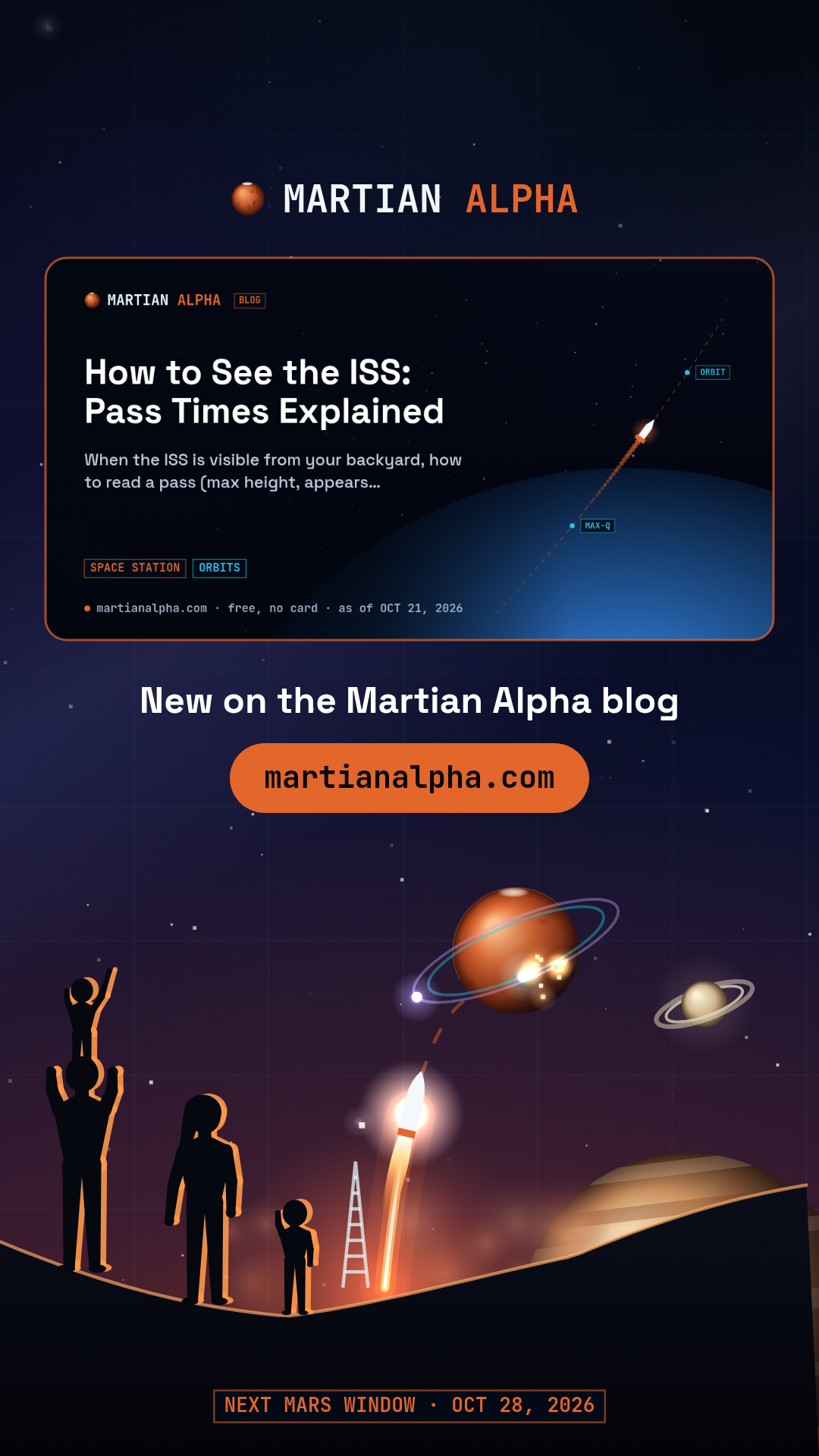
How to See the ISS: Pass Times Explained
When the ISS is visible from your backyard, how to read a pass (max height, appears, disappears) and where the predictions come from, with NASA's rules.
You can see the International Space Station with your bare eyes, but only around dawn or dusk, when it's still lit by the Sun while your sky is dark. NASA says it looks like a bright star or airplane moving steadily across the sky, without flashing lights, and travelling much faster than a plane: about 17,500 miles an hour (28,000 km/h) against roughly 600 miles an hour for an airliner. How often you get a good pass depends on where you live, from about one a month to several a week. NASA's free Spot the Station site gives a two-week schedule for your city.
Why you can only see it at dawn or dusk#
NASA's Spot the Station FAQ explains that the ISS is visible because it reflects sunlight, the same reason we see the Moon. Unlike the Moon, it isn't bright enough to see in daytime. All sightings happen within a few hours before or after sunrise or sunset, when the Sun still reaches the station but the sky around you is dark. A station that passes over you at midday or in the middle of the night is overhead but can't be seen.
Facts from NASA's station facts page that explain the rhythm:
- The station orbits Earth about every 90 minutes and makes 16 orbits in 24 hours, passing through 16 sunrises and sunsets.
- Its orbital path takes it over 90 percent of Earth's population.
- The solar arrays are large enough that it can be seen even from big cities.
How to read a pass#
A pass listing has five fields, as NASA defines them on its Spot the Station FAQ:
| Field | What it means |
|---|---|
| Time | When the sighting starts, in your local time |
| Visible | The longest time the station stays visible before dropping below the horizon |
| Max height | The highest point in the sky, in degrees: horizon is 0, straight overhead is 90 |
| Appears | Where in the sky it first becomes visible |
| Disappears | Where it leaves your view |
Two practical details from NASA:
- A closed fist held at arm's length resting on the horizon reaches about 10 degrees, which gives you a quick way to judge height.
- NASA only sends alerts for passes that reach at least 40 degrees, because those are visible above most landscapes and buildings. If the station "appears and disappears in the same direction", that's usually a short pass where it moves quickly into or out of Earth's shadow, and directions are rounded to the nearest compass point.
How often will you see it?#
NASA says the number ranges from one sighting opportunity a month to several a week, because it must be dark where you are and the station must happen to pass overhead. If your exact town isn't listed on Spot the Station, NASA says to use the closest one: the station is visible within about 50 miles (80 km) of each listed location.
Where predictions come from#
Pass predictions are calculated, not observed. The orbit of each object is described by a small set of numbers, usually published as a two-line element set (TLE). CelesTrak's format reference lists the fields: inclination, right ascension of the ascending node, eccentricity, argument of perigee, mean anomaly, mean motion in revolutions per day, a drag term and an epoch, the date the numbers apply to. A propagation model then moves the object forward from that epoch to predict where it will be.
That's why every tracker should be treated as a forecast: the further the prediction is from the epoch of the element set, the less certain it is, and a spacecraft's orbit changes when it fires its thrusters or when drag acts on it. Trackers that refresh their element sets often give better short-term predictions.
What else crosses your sky#
The same method works for any satellite with a published orbit. The China Space Station (Tiangong) can be tracked this way, and so can newly launched batches of Starlink satellites, which fly as a tight line of dots for a few days after launch before spreading out to their working orbits. Our guide to Starlink satellite counts explains how many are up there.
Try it on Martian Alpha#
Martian Alpha's What's Overhead page shows a live map of the ISS, Tiangong and recent Starlink trains and lists who is in space right now. The map is open to everyone. Pass times for your location and the full crew list need a free Martian Alpha account. It computes its predictions in your browser from public orbital elements. NASA's Spot the Station also gives a free two-week schedule and email or text alerts, so use whichever you prefer.
FAQ#
What time is the ISS visible tonight?#
It depends on your location, but always within a few hours of sunrise or sunset. NASA's Spot the Station gives a two-week schedule for your city, and What's Overhead gives pass times for your location with a free account.
Do I need a telescope to see the ISS?#
No. NASA says you can see it with your bare eyes.
How can I tell the ISS from an airplane?#
NASA says it looks like an airplane or a very bright star, but it has no flashing lights, doesn't change direction and moves much faster than a plane.
Why does the ISS sometimes appear and disappear from the same direction?#
Usually because it's entering or leaving Earth's shadow quickly, so the visible part of the pass is short, and directions are rounded to the nearest compass point.
How accurate are ISS pass predictions?#
They come from orbital element sets with an epoch, so they're most accurate close to that date. Use a tracker that updates its elements often, and check again on the day.
Sources#
- NASA, Spot the Station FAQ: https://spotthestation.nasa.gov/faq.cfm
- NASA, International Space Station Facts and Figures: https://www.nasa.gov/international-space-station/space-station-facts-and-figures/
- CelesTrak, NORAD Two-Line Element Set Format: https://celestrak.org/NORAD/documentation/tle-fmt.php
This article is for information only and is not financial advice. Do your own research before making any investment.