 Martian Alpha
 Starlink Satellite Count: Why Trackers Disagree
Why Starlink satellite counts differ between trackers, what launched vs in-orbit vs working means, and how to verify a timestamped count yourself.
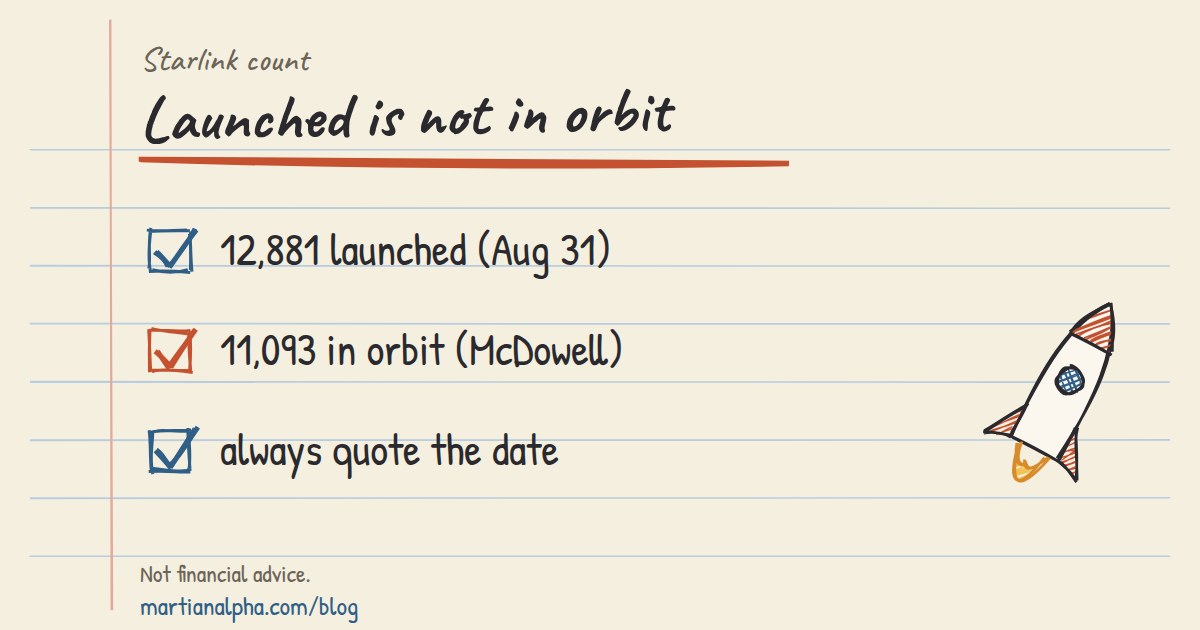
Counts updated October 4, 2026: Jonathan McDowell's Starlink statistics (data as of August 31, 2026) list 12,881 satellites launched, 11,093 in orbit and 11,078 working; KeepTrack showed 11,156 in orbit on October 3, 2026. The version of this post published in September 2026 gave an in-orbit range of 8,600 to 8,900, which was out of date at the time. Use the steps below with a live tracker for today's numbers.
Most trackers put the number of Starlink satellites in orbit in a range rather than a single figure, and the cumulative launched total is higher still. That gap between launched and active exists mostly because SpaceX has deliberately deorbited older units: McDowell's table counts 1,788 Starlink satellites down as of August 31, 2026, including 1,438 completed disposals. Independent analysts like Jonathan McDowell track this distinction closely, and live numbers shift by dozens most weeks as new batches launch and old satellites reenter.
TL;DR:
- As of late summer 2026, trackers put Starlink satellites in orbit at roughly 11,100 (McDowell: 11,093 on August 31; KeepTrack: 11,156 on October 3), against about 12,900 launched; the gap is deorbited and failed satellites.
- Satellite counts fluctuate daily because of continuous launches, deorbiting, and differences in tracker refresh cycles, making the precise in-orbit number a range rather than a fixed figure.
- Tracking tools rely on orbital data from U.S. surveillance sources, but filtering, manual curation, and snapshot timing significantly influence the reported active count.
- The distinction between launched, in-orbit, working, and deorbited satellites is crucial for accurate assessments, with only the in-orbit or working counts reflecting current service capacity.
- Newly launched satellites form visible trains that gradually disperse over weeks, and SpaceX actively reduces space debris by operating satellites at lower altitudes for faster reentry.
What Is the Current Starlink Satellite Count?#
Pin down an exact figure and you'll be wrong within a day. That's not a knock on anyone's math. It's just how a constellation this size behaves when SpaceX is launching new batches roughly every few days while simultaneously retiring satellites that have reached the end of their working life.
The most useful way to think about the Starlink satellite count is as a range, not a single integer. In late summer 2026, catalog-based trackers reported roughly 11,100 Starlink satellites in orbit, while the cumulative launched total was close to 12,900 (McDowell, August 31, 2026: 12,881 launched, 11,093 in orbit). The difference, about 1,800 satellites, represents units that have already deorbited, failed on ascent, or were intentionally retired after their operational lifespan.
Here's how a few major sources compared recently:
- Planet4589: catalog-derived constellation statistics that many other trackers use as a backbone dataset.
- OrbitalRadar: a near-real-time active counter that updates frequently and applies its own filtering logic for what counts as "active."
- KeepTrack: an aggregator that shows the same core pattern, launched totals exceeding in-orbit totals by a wide margin, using slightly different snapshot timing.
The number that actually matters for most readers isn't the raw launched total. It's the working, in-orbit count, and even that varies by a few hundred depending on which tracker's refresh cycle you catch. Snapshot timing explains most of the disagreement you'll see between sites. One tracker refreshed six hours ago will show a different number than one refreshed six minutes ago, especially right after a launch when a new batch of satellites is still climbing to operational altitude.
If you're building a model or writing about the constellation, use a conservative working number rather than the headline "total launched" figure. Total launched is a historical tally. It counts every satellite SpaceX has ever put into space, including ones that failed early or were deliberately deorbited years ago. Active in-orbit count is the number that reflects what's actually providing service today. Confusing the two is the single most common mistake in casual reporting on constellation size, and it's an easy one to avoid once you know which figure you're citing.
How Do Trackers Actually Measure the Starlink Count?#
Every live counter you've ever seen traces back to the same root data: orbital catalogs maintained by U.S. space surveillance systems. Two names come up constantly here, Space-Track and CelesTrak, and understanding what they actually publish clears up a lot of confusion about why numbers differ.
Space-Track and CelesTrak both distribute what's called a Two-Line Element set, or TLE, for every tracked object in orbit. A TLE is a compact string of orbital parameters, altitude, inclination, eccentricity, that lets software calculate where an object will be at any given moment. It's not a live GPS feed. It's a mathematical snapshot that goes stale after a few days without an update, which is one reason different trackers can report slightly different active counts even when they're pulling from the same underlying catalog.
Live trackers and visualizers ingest these catalog entries and then apply their own filtering logic:
- They cross-reference object names and international designators to isolate Starlink-specific entries from the tens of thousands of other cataloged objects.
- They flag objects with decaying orbits or unusual altitude drops as likely deorbiting or already reentered.
- They exclude or separately label satellites still in early orbit-raising, since those aren't yet operational.
- Some apply manual curation, cross-checking automated flags against launch manifests and news of anomalies.
That manual layer is where independent analysts add real value. Automated catalog filtering can miss context that a human tracking the program closely would catch, like a batch that experienced a partial failure or a satellite that's been quietly deorbited ahead of schedule. Jonathan McDowell's tallies are widely cited precisely because they separate launched, in-orbit, and working figures with that kind of scrutiny applied.
The limitations are worth knowing. Catalog updates lag real-world events by hours to days. Orbital maneuvers, which Starlink satellites perform constantly for station-keeping and collision avoidance, can temporarily confuse tracking software about a satellite's status. And failed units sometimes sit in the catalog for weeks before they're formally reclassified as non-functional, since ground controllers need to confirm a failure before updating its status.
Pro Tip: If you're comparing two trackers and their numbers don't match, check the timestamp before you assume one is wrong. A four-hour-old snapshot after a launch week can easily be off by fifty or more satellites from a live one.
Launched vs. In-Orbit vs. Working vs. Deorbited: What's the Difference?#
These four terms get used interchangeably in casual conversation, and that's exactly why so much confusion exists about the real Starlink satellite count. Each one measures something distinct.
- Launched is the cumulative total of every Starlink satellite SpaceX has ever put into space, going back to the first prototypes in 2019. This number only ever goes up. It never decreases, even when satellites fail or deorbit, because it's a historical count of launch events, not a current inventory.
- In-orbit refers to satellites currently in space according to the tracked catalog, regardless of whether they're functioning normally. This is a snapshot figure, not cumulative, and it drops every time a satellite reenters the atmosphere.
- Working (or active/operational) is the subset of in-orbit satellites actually providing service to customers. This excludes satellites that have failed but haven't yet deorbited, and it excludes satellites still climbing to their assigned shell after launch.
- Deorbited covers satellites that have reentered Earth's atmosphere, either through controlled deorbit maneuvers SpaceX initiates for aging or failed units, or through natural atmospheric drag pulling a dead satellite down over months.
Here's a worked example of how these numbers relate. On McDowell's August 31, 2026 table, for example, launched (12,881) exceeds in orbit (11,093) by 1,788. Some of these are satellites that have deorbited or failed outright, while others may still be in commissioning, not yet fully operational.
That commissioning category trips up a lot of casual trackers. Some live counters lump commissioning satellites in with fully operational ones, which inflates the "active" number you see on a given site. Others exclude them entirely, which can make the working total look lower than it really is once those satellites come online in the following weeks. Neither approach is wrong, but knowing which one a tracker uses changes how you should interpret its headline figure.
For how Starlink compares with other operators' networks, see our guide to satellite constellations.
Where Are Starlink Satellites Positioned in Orbit?#
Starlink isn't one flat ring of satellites circling at a single altitude. It's a multi-shell architecture, with different groups of satellites occupying distinct altitude and inclination bands, each serving a specific coverage purpose.
The bulk of the constellation sits in low Earth orbit at altitudes roughly between 340 and 570 kilometers, spread across several shells with different inclinations. Lower shells generally deliver lower latency because signals travel a shorter round trip, but they also mean each satellite covers less ground area and decays faster due to stronger atmospheric drag. Higher shells trade a bit of latency for broader coverage per satellite and longer orbital lifespans.
A few things worth understanding about shell distribution:
- Different inclinations let SpaceX cover different latitude bands, including polar and near-polar shells that extend service toward higher latitudes.
- New launches don't spread evenly across all shells immediately. A batch typically targets one specific shell that needs reinforcement, which is why shell-level counts can shift sharply after a single launch while the total in-orbit number moves only modestly.
- Satellites spend days to weeks in a lower "parking" orbit before firing thrusters to raise themselves into their assigned operational shell, which temporarily concentrates a cluster of satellites at an altitude where they won't stay.
This orbit-raising phase matters for anyone trying to read too much into a single day's count. A launch that adds 20 to 28 satellites doesn't immediately add 20 to 28 satellites of capacity to a specific region. It adds them to a transit orbit first, and regional coverage improvements show up gradually as each satellite reaches its assigned shell over the following one to three weeks. If you're tracking counts to gauge coverage improvements in a specific area, the shell distribution matters more than the raw total.
How Has the Starlink Constellation Grown Since 2019?#
The growth curve here is genuinely unusual for a space program, and the pace has only accelerated as SpaceX's launch cadence matured.
- 2019: SpaceX launched its first batch of 60 Starlink prototypes in May, marking the constellation's operational debut after earlier test satellites.
- 2020: Regular batch launches began in earnest, with SpaceX flying multiple missions of roughly 60 satellites each throughout the year, building toward an initial operational shell.
- 2021 to 2022: Launch cadence increased significantly, with SpaceX introducing satellites with improved design and beginning to fill out additional orbital shells beyond the first.
- 2023 to 2024: SpaceX shifted much of its Starlink deployment to Falcon 9's reusable boosters flying at a rapid pace, often launching multiple Starlink missions per week during peak periods, while also beginning to deorbit the earliest first-generation units nearing end of life.
- 2025 to 2026: Launch cadence has remained aggressive, with batches typically carrying 20 to 28 satellites per mission depending on the rocket configuration and target shell, pushing cumulative launched totals to about 12,900 by the end of August 2026 (McDowell).
That last point about batch size matters for reading any given week's news. A single Falcon 9 mission today typically deploys somewhere in the 20s of satellites, not the 60 that defined the earliest missions. Rocket configuration and target orbit both affect exactly how many ride along on a given flight.
After each launch, expect a lag before the full batch shows up as "active" on most trackers. Commissioning, the process of checking out each satellite's systems and raising it to operational altitude, typically takes one to three weeks. A tracker that shows a sudden count increase the day after a launch is likely counting the batch as in-orbit but not yet working, so don't be surprised if the "active" figure on a different site lags behind by that same window.
Why Do "Starlink Trains" Appear in the Sky?#
If you've ever seen a string of bright dots moving in a perfect line across the night sky and wondered what you were looking at, you've spotted a Starlink train, and it's directly tied to how the constellation gets deployed.
Newly launched satellites ride together to their initial parking orbit and stay tightly clustered for days after deployment while they wait to begin raising themselves individually to their assigned shells. During that window, they reflect sunlight in a way that makes them visible as a line of moving points, which is exactly why visibility spikes noticeably in the days following a launch. Over the following one to two weeks, the train gradually spreads apart as each satellite maneuvers independently, and the visual effect fades.
This phenomenon has drawn real pushback from the astronomy community, and SpaceX has made changes in response:
- Astronomers flagged that bright, moving satellite trails were contaminating long-exposure images used for research, particularly wide-field surveys looking for faint objects.
- SpaceX introduced a visor design intended to reduce sunlight reflection off newer satellite batches.
- The company has also adjusted satellite orientation during orbit-raising to minimize how much sunlight reflects toward ground observers.
The visibility problem is temporary by design, but the debris question is a longer-running concern that ties directly back to the numbers this article keeps circling. Atmospheric drag at low-Earth-orbit altitudes causes satellites to decay and naturally reenter within a matter of years rather than remaining as long-term debris. This is part of why SpaceX deliberately operates at lower altitudes than many legacy satellite programs. That deliberate deorbiting practice, retiring aging or failed satellites rather than leaving them in orbit indefinitely, is also a direct driver of the gap between total launched and current in-orbit counts you'll see on every major tracker.
What Are the Best Tools to Track Starlink Satellites Live?#
You don't need a background in orbital mechanics to check the current Starlink satellite count yourself. A handful of public tools do the heavy lifting, and knowing what each one actually shows makes the numbers far easier to trust.
- OrbitalRadar publishes a near-real-time active count alongside visual constellation maps, useful if you want a quick headline figure without digging into raw catalog data.
- KeepTrack offers a more detailed breakdown, including launched-versus-active comparisons and historical trend data.
- Planet4589 provides catalog-derived statistics that function more like a primary dataset than a polished consumer dashboard, ideal if you want the numbers other trackers are built on.
Once you're looking at any tracker, check three things before trusting the number: the timestamp of the last refresh, whether the site filters out commissioning satellites or lumps them into "active," and whether the figure represents total launched or current in-orbit count. Those three checks resolve most of the apparent contradictions between sites.
A few practical habits make ongoing monitoring far less tedious. Bookmark two trackers rather than one, so you can spot-check discrepancies instead of taking a single source at face value. If you're tracking visible passes for observation purposes rather than raw counts, pair a constellation tracker with a dedicated pass-prediction tool that accounts for your specific location and local sunset and sunrise times, since visibility windows are short and highly location-dependent.
What Do Satellite Count Changes Actually Signal?#
For anyone using constellation size as an input into broader analysis, whether that's coverage modeling, capacity estimates, or just tracking the health of the program, the raw number matters less than the trend and the context behind a sudden shift.
Operational satellite count correlates loosely with user capacity and coverage density, but it's not a clean one-to-one relationship. Adding satellites to an already dense shell improves redundancy and peak-hour bandwidth more than it expands new coverage area, while adding satellites to a sparse or new shell, like a polar-inclination group, can open service to regions that had none before. Reading a count increase without knowing which shell it landed in tells you less than you'd think.
Sudden changes deserve scrutiny before you draw conclusions. A sharp jump usually just reflects a normal launch batch entering the catalog. A sharp drop is more interesting: it could mean a batch of aging satellites hit scheduled deorbit, or it could signal an anomaly affecting an entire launch group, which has happened before with batches caught in bad weather-related atmospheric conditions shortly after deployment.
The conservative approach for building any model: use a time-stamped working-satellite figure rather than a launched total, update your baseline weekly rather than daily to smooth out launch-week noise, and flag any single-week change larger than a typical batch size for manual review rather than assuming it's routine.
Using Martian Alpha to Monitor Starlink and Market Signals Together#
Tracking satellite counts in isolation only tells half the story if you're trying to connect fleet growth to what it means for the companies behind it. A satellite constellation tracker can sit alongside a launch calendar, automated alerts, and a CANSLIM equity screener, so a launch that adds to the Starlink count shows up in the same view as the market reaction to it.
A practical daily workflow looks like this: check the constellation tracker each morning for overnight changes, cross-reference any large jump or drop against the launch calendar to confirm whether it was a scheduled mission or something unplanned, and use the catalyst feed, contract award ticker and News Sentiment Score to see awards and coverage tied to the companies involved. A macroeconomic briefing system can add context around whether a given week's launch cadence lines up with broader capital spending trends across the sector, rather than treating each data point in isolation.
For analysts specifically, this matters because a satellite count on its own is just a number. Paired with contract award data and AI-powered company analysis, a sudden deployment surge or an unexpected deorbit event becomes something you can actually act on, rather than a headline you read and forget.
Why Ranges Beat Single Numbers in Satellite Tracking#
Anyone who has tried to cite a precise Starlink satellite count in a report and had it look outdated within a week learns this lesson fast: a single integer is a liability, not a credential. It signals false precision about a number that's moving constantly.
The better habit is citing a time-stamped range from a primary catalog snapshot, alongside a separate, also time-stamped, independent analyst tally when the two don't perfectly agree. That disagreement isn't a flaw in either source. It's a feature of measuring something that changes daily. When trackers genuinely conflict, lean toward the analyst figure that explicitly separates launched from working, since that distinction usually resolves the gap.
Keep a simple watchlist for sudden changes rather than trying to track every satellite individually. A jump or drop that breaks pattern is worth investigating. A steady climb in line with normal launch cadence isn't.
Track Launches and Market Signals in One Place#
There are platforms that combine a satellite constellation tracker, launch calendar, and automated alerts with company profiles, contract award feeds, and news sentiment scoring, so a deployment update and its market context show up together instead of across separate tools.
The core research tools remain free, including the launch calendar and constellation tracker, and the CANSLIM screener is free too; paid plans add higher AI limits and power-user tools (see the plans page). If you're already checking satellite counts by habit, set up a free account and add the launch calendar to your regular routine. The next launch alert lands in your feed instead of a separate tab you forgot to refresh.
Where to Verify Starlink Satellite Counts Yourself#
Every figure in this article traces back to publicly checkable sources, and it's worth bookmarking a few of these directly rather than relying on secondhand summaries.
- Federal Communications Commission (FCC): official regulatory filings that establish licensing ceilings for the Starlink constellation.
- Planet4589: catalog-derived constellation statistics widely used as a baseline dataset by other trackers.
- OrbitalRadar and KeepTrack: live, frequently updated active-satellite counters with slightly different filtering methods.
- Space: context on how experts like Jonathan McDowell separate launched, in-orbit, and working tallies.
- ESA's space debris statistics: background on orbital decay and reentry behavior relevant to attrition rates.
Sources#
- Federal Communications Commission (FCC)
- Space
- OrbitalRadar — How many Starlink satellites
- Planet4589
- KeepTrack — Starlink satellite count
FAQ#
Why Does Starlink Need Up to 42,000 Satellites?#
The 42,000 figure comes from SpaceX's FCC filings, which set a regulatory ceiling rather than a committed launch plan. It represents the maximum SpaceX has sought approval for across multiple orbital shells, not a number the company has announced it will definitely reach.
Is Starlink Faster Than 5G?#
Starlink's satellite internet and 5G cellular service solve different problems rather than directly competing on raw speed. Starlink typically delivers strong performance in areas without fiber or dense cell coverage, while 5G generally outperforms satellite internet on latency in urban areas where cell towers are dense.
How Many Starlink Satellites Are Lost Every Day?#
There's no fixed daily loss rate. Satellites deorbit in batches, either through intentional retirement of aging units or natural atmospheric drag pulling down failed satellites, which is why total launched consistently exceeds in-orbit totals by thousands rather than declining at a steady daily pace.
Which Country Has 763 Satellites?#
This figure doesn't correspond to a documented national satellite count in current public tracking data, and no reliable source ties it specifically to Starlink or a single country's constellation. If you encountered this number in another context, it's worth checking the original source directly rather than assuming it applies to the Starlink fleet.
What's the Difference Between Launched and In-Orbit Starlink Numbers?#
Launched is a cumulative historical total that only increases, while in-orbit is a current snapshot that drops whenever satellites deorbit. Analysts typically report these as two separate figures precisely because conflating them misrepresents the constellation's actual current size.
Can I Track Starlink Launches and Market Activity in the Same Place?#
Yes. Martian Alpha combines a satellite constellation tracker with a launch calendar, automated alerts, and company analysis tools in one terminal. Core tracking features, including the constellation tracker and CANSLIM screener, are free; paid plans add higher AI limits and power-user tools.
This article is for information only and is not financial advice. Do your own research before making any investment.