 Martian Alpha
 Validation Gates for AI Space Stock Analysis for Investors
A practical playbook for investors using AI on space stocks: six step workflow, sector specific signals, backtests, and human validation gates.
AI space stock analysis means applying machine learning and language models specifically to publicly traded space and space-exploration companies, not generic AI-sector stocks. It works by aggregating launch schedules, contract awards, and financial filings into event-driven signals faster than manual research ever could. Investors who treat it as a research accelerator, not an oracle, gain a real edge on catalyst-driven names.
TL;DR:
- AI analysis for space stocks focuses on sector-specific data like launch schedules, contract awards, and operational metrics, not general AI stocks.
- Building a reliable workflow requires ingesting fundamentals, applying technical signals, synthesizing insights with large language models, and human validation.
- The most accurate models present probability scores for stock movements, calibrated through metrics like the Brier score, and depend on accurate input data like launch costs and backlog figures.
- Sector signals include launch cadence, government contracts, and market technicals, but models can break down due to biased datasets or unrealistic cost assumptions.
- Martian Alpha offers free, space-specific research tools (screener, launch calendar, catalyst feed), emphasizing primary source verification like NASA data and filings before acting on AI-generated signals.
What Makes AI-Powered Space Stock Analysis Different?#
AI space stock analysis is not the same thing as scanning a list of "AI stocks." It is a sector-specific discipline: applying machine learning and large language models to the financials, contracts, and operational data of companies that build rockets, satellites, and orbital infrastructure. Confuse the two, and you end up reading semiconductor commentary when you needed launch-manifest data.
A working pipeline for this sector has four moving parts. First, structured datasets: earnings, backlog, government contract feeds, and launch calendars. Second, machine learning technical signals, the kind that flag momentum shifts in thinly traded names before headlines catch up. Third, large language model synthesis that reads earnings calls, filings, and news, then summarizes what actually changed. Fourth, event detectors tuned to space-specific catalysts, since a scrubbed launch or a NASA contract award moves these stocks in ways a generic stock screener never anticipates.
Goldman Sachs frames AI and falling launch costs as the two forces reshaping the space economy together, since cheaper access to orbit is what makes on-orbit computing and autonomous satellite operations economically viable in the first place. That matters for stock analysis because it means the AI layer is not just reading the sector, it is part of what is changing the sector's economics.
Launch cadence, contract award timing, and constellation deployment metrics are the catalysts that matter here, and none of them show up in a standard AI stock analysis tool built for tech or software names.
How Do You Build an AI-Assisted Research Workflow for Space Stocks?#
A repeatable process beats a one-off AI query every time. Here is the sequence disciplined investors follow:
- Ingest the fundamentals first. Pull financials, backlog-to-revenue ratios, launch manifests, SEC filings, and supplier order flow before running any model. Garbage data in produces confident-sounding garbage out.
- Run machine learning technical overlays. Momentum indicators and volatility scores flag when a stock's price action has decoupled from its fundamentals, a common pattern in low-float space names.
- Layer in multi-agent language model synthesis. One open-source project, OrbitalAssets, runs a four-phase reasoning pipeline covering astrophysical, astrodynamic, economic, and risk analysis, converting raw NASA data into structured investment output with a visible reasoning trail.
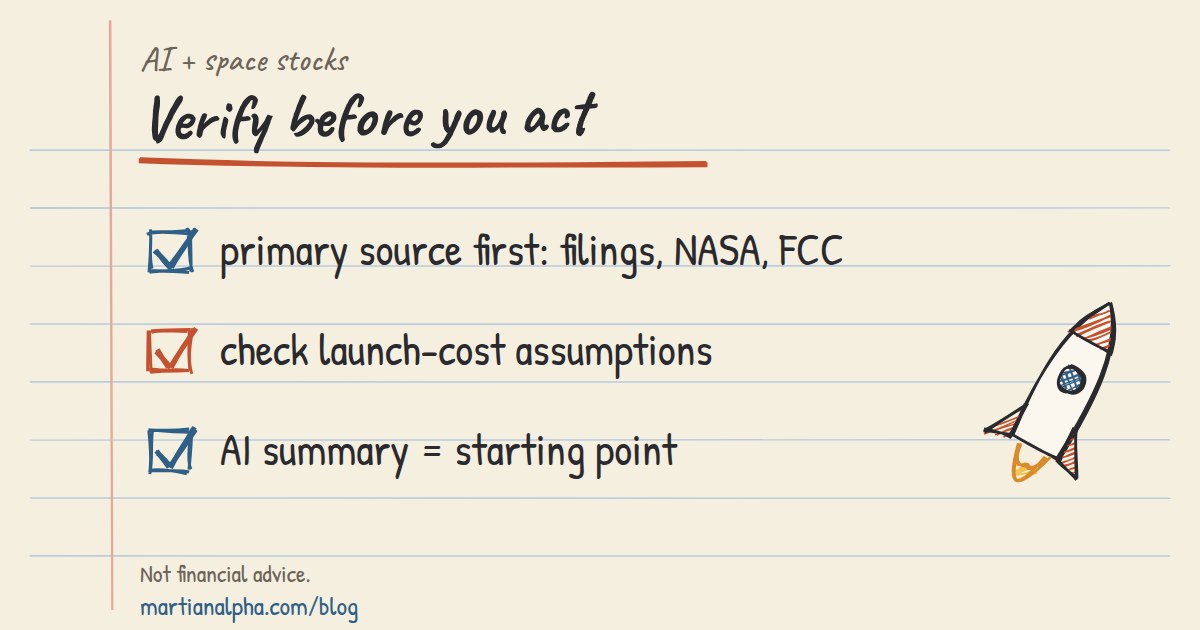
- Apply a human validation gate. No AI output should trigger a trade without a person checking it against the primary source, whether that is a filing, a launch manifest, or a contract announcement.
- Backtest and calibrate. Track how often the model's stated confidence matches reality using a Brier score, the standard measure for how well probability forecasts line up with outcomes.
- Set your cadence. Daily briefs for price action, weekly reviews for thesis drift, and immediate rechecks whenever a named catalyst (launch, contract, earnings) hits.
Pro Tip: Treat any AI-generated stock call as a hypothesis, not a conclusion. If the model can't point to the specific filing, launch date, or contract line item behind its confidence score, don't trade on it.
One public tracker, the spacex-ipo-tracker, demonstrates this in practice, publishing daily audited calls that combine nine machine learning signals with a multi-agent large language model setup running Bull, Bear, and Judge roles against each other before producing a verdict.
What Signals Should an AI Pipeline Track for Space Stocks?#
The best AI stock analysis tools for this sector fuse several signal categories into a single probability, rather than treating each in isolation.
- Operational signals: launches per quarter, backlog-to-revenue conversion rate, and rocket reliability history by vehicle family.
- Contract and funding signals: government contract award feeds, agency budget cycles, and supplier order flow that hints at upcoming production ramps.
- Market signals: RSI, MACD, and moving-average stacks combined into machine learning ensemble scores rather than read individually.
- Edge data: satellite telemetry proxies, public launch manifest scraping, and auditable open-source briefs published on platforms like GitHub.
OrbitalAssets' pipeline shows how far this can go technically. It runs NPV modeling with heavy discounting and market-damping factors, alongside risk engines that apply deal-breaker checks, such as condition-code thresholds that automatically flag a thesis as broken.
The output that matters most is a probability triplet, essentially the model's confidence split across "price goes up," "stays flat," or "goes down." A model's real value shows up in its Brier score, the calibration metric that tells you whether a system's 70% confidence calls actually come true about 70% of the time. A model that is right 9 times out of 10 but never says so with matching confidence is not actually useful for sizing positions.
Where Does AI Stock Analysis Break Down for Space Names?#
AI models are only as good as the assumptions baked into them, and space stocks expose that fast. Orbital compute investment theses often lean on optimistic launch-cost projections, such as per-kilogram prices that only a fully reusable heavy rocket could deliver. Check the assumption against something published: SpaceX's own 2024 price list puts a standard Falcon 9 launch at $69.75 million for up to 5.5 tonnes to geostationary transfer orbit (SpaceX Capabilities & Services). Get that input wrong, and every downstream valuation is fragile.
Other failure modes to watch for:
- Thinly traded names are prone to narrative-driven retail squeezes that have little to do with fundamentals, particularly around headline events tied to a marquee private company like SpaceX.
- Overfitting and dataset leakage can make a backtest look great and a live model perform poorly; four checks that expose false edges in AI stock research covers how to spot both.
- Source bias creeps in when a model over-weights one dataset (say, social sentiment) over harder data like backlog conversion.
Pro Tip: Set a confidence gate before you start, not after a bad trade. If a model's stated confidence falls below your threshold, the answer is no position, not a smaller one.
Where This Is Headed for Disciplined Investors#
Institutional coverage of space stocks is thin today, which is exactly why AI-driven research tools matter more here than in crowded sectors. Expect sell-side coverage to expand as total addressable market projections through 2035 draw more capital into the supply chain, and expect the better models to shift from narrative proxies toward genuine valuation integration, meaning NPV and cash-flow modeling rather than sentiment scoring alone. My honest expectation: the investors who win here are the ones who start now with a watchlist, run their models through a real backtest, and build the discipline to trust a calibrated confidence score over a hot take.
How Martian Alpha Fits This Workflow#
Everything described above, from launch calendars to contract feeds to AI-driven company analysis, is what Martian Alpha was built around. Martian Alpha is the domain-focused alternative to piecing together spreadsheets, generic screeners, and separate news feeds. Instead of hunting across five different tools to build one thesis, you get a CANSLIM equity screener, a live launch and catalyst calendar, AI-powered company profiles, automated alerts, and a community feed built specifically around publicly traded space companies.
That domain focus is the real time savings. A generic AI stock analysis tool has to be taught what a launch cadence or a contract backlog even means; Martian Alpha starts there. The free tier gives you the core research tools with no cost, while paid plans add higher AI limits and power-user tools (see the plans page for current pricing). Head to the Martian Alpha terminal and start building your watchlist today.
Where to Verify AI-Generated Space Stock Calls#
Never trust a model output without checking it against a primary source. Cross-reference AI-generated theses against NASA and JPL public data, company SEC filings, official launch manifests, and auditable open briefs like OrbitalAssets on GitHub. For sector-level context, Goldman Sachs and VisualCapitalist both publish research worth tracking regularly.
Sources#
Company filings, launch manifests, government contract award feeds, and backlog-to-revenue figures matter most, since these directly drive space company revenue. Market-based technical signals like RSI and MACD add a second layer, but they should never substitute for the underlying operational data.
- How falling launch costs and AI are driving the space economy — Goldman Sachs
- The fastest-growing space economy sectors by 2035 — VisualCapitalist
FAQ#
What Is AI Space Stock Analysis?#
It is the use of machine learning and language models to analyze publicly traded space and space-exploration companies, combining financial data, launch schedules, and contract feeds into investment signals. It differs from general AI-stock research because it relies on sector-specific catalysts like launch cadence and government contract awards rather than broad market indicators.
How Reliable Are AI-Driven Space Stock Predictions?#
Reliability depends entirely on calibration, not raw model confidence. A well-built system tracks its accuracy over time using a Brier score and publishes that record openly, as seen in trackers like the spacex-ipo-tracker, rather than asking investors to simply trust its output.
Does Martian Alpha Offer Free AI Stock Analysis Tools for Space Companies?#
Yes, Martian Alpha's core research tools, including its CANSLIM screener and launch calendar, are available on a free tier, with paid plans adding higher AI limits and deeper data.
Can AI Replace Traditional Fundamental Analysis for Space Stocks?#
No. AI accelerates data aggregation and pattern detection, but it cannot replace human judgment on qualitative risks like program cancellations or leadership changes. The strongest approach pairs AI-generated signals with a human validation step before any trade decision.
This article is for information only and is not financial advice. Do your own research before making any investment.