 Martian Alpha
 4 Checks That Expose False Edges in AI Stock Research
Evidence first guide for investors: vet AI stock research with four checks, RETuning bias controls, backtest hygiene, and a sector case study.
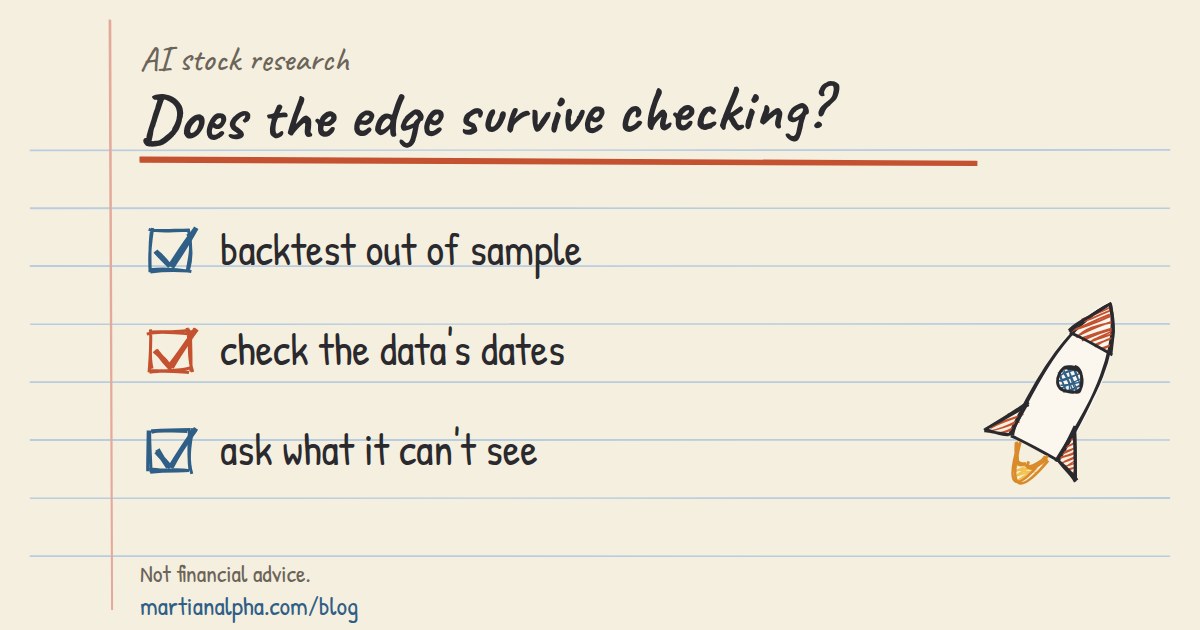
AI can speed and scale stock research as an assistant, not a guaranteed source of alpha. It excels at synthesis: compressing filings, earnings calls, and news into readable signal. It fails at reliable prediction once markets adjust to it. Treat every output as a hypothesis, and verify it against provenance data and long-horizon backtests before it touches a position.
TL;DR:
- AI excels at synthesizing financial data and surfacing investment candidates but struggles to produce reliable, repeatable market predictions.
- Techniques like RETuning improve reasoning robustness, yet most forecasting models tend to overfit and lose effectiveness in live markets.
- Long-term, wider horizon tests reveal that apparent AI advantages often diminish or reverse, especially after market changes and increased adoption.
- Data flaws and manipulation risks pose significant dangers, making transparency and verification essential before trusting AI-driven signals.
- Sector-specific AI tools like Martian Alpha provide better provenance and explainability, emphasizing the importance of verified data over generalist models.
How AI in Stock Research Actually Gets Used#
Most investors don't need AI to predict the market. They need it to survive the volume of data the market generates every day. That's where AI in stock research earns its keep right now, in synthesis and screening, not in crystal-ball forecasting.
The practical applications cluster into a few categories.
- Screening and signal generation — automated factor scans and feature engineering that surface candidates a human analyst would take days to find manually.
- Text and news synthesis — large language models condensing earnings call transcripts, 10-K filings, and social sentiment into digestible summaries.
- Research briefs and idea generation — LLMs drafting first-pass hypotheses and thematic reports that a researcher then stress-tests.
- Price and movement forecasting — the most attempted, least reliable use case, where models tend to overfit historical patterns that don't survive live markets.
That last point deserves emphasis. Forecasting models frequently mistake correlation in training data for a repeatable edge. When a model's "prediction" leans heavily on recent sentiment rather than independently weighed evidence, the failure mode is systemic, not accidental. Screening and synthesis have a much better track record than prediction, and that split should shape where you spend your evaluation time.
Technical Approaches: LLMs, Time-Series Models, and Bias Correction#
Different AI techniques solve different problems, and conflating them is where a lot of investor confusion starts. Large language models handle language. Time-series machine learning handles pattern detection in structured numerical data. They are not interchangeable tools.
LLMs used for stock movement prediction often exhibit a specific weakness: they echo the sentiment already present in their context window rather than independently weighing conflicting evidence, as shown in analyses from BitPulse that explore sentiment-analysis techniques applied to crypto and markets. A method called RETuning addresses this directly by forcing the model to build and score evidence on both sides before committing to a prediction, which measurably improves reasoning robustness on large financial datasets. Time-series ML, by contrast, relies on ensemble models trained on price, volume, and volatility data. Sentiment pipelines sit somewhere in between, scoring news and social data as structured features for other models.
The tool landscape splits into three broad categories:
- Research terminals that package screening, news, and AI summaries into one workflow.
- Model toolkits for researchers who want to build and fine-tune their own forecasting pipelines.
- Data vendors supplying the raw price, filing, and alternative datasets everything else runs on.
Pro Tip: Ask any AI research tool whether it scores opposing evidence explicitly or just summarizes the loudest opinion in the room. The former is closer to RETuning-style rigor; the latter is a sentiment echo chamber wearing a research label.
What the Evidence Actually Shows#
The headline results in AI stock research are more fragile than they look on first read, and knowing why separates a useful tool from an expensive mistake.
A widely cited Stanford GSB study simulated an "AI analyst" that rebalanced mutual fund portfolios quarterly across three decades of history, from 1990 to 2020, and produced substantially higher simulated returns than human fund managers over that window. That is a genuinely striking result. It's also a controlled backtest, and the researchers themselves caution that such gains may shrink once enough market participants adopt similar tools, since any edge that depends on being early tends to erode with crowding.
A study simulating an AI stock-picking analyst across 1990–2020 found substantially higher historical returns than human managers, but the authors explicitly warn the advantage may not persist as adoption spreads.
Broader, longer evaluations back up that caution. Research testing LLM-based investing strategies over longer horizons and wider stock universes finds that reported advantages often shrink or reverse once you test across more symbols and more decades rather than one favorable window. This matters because a single flashy backtest is not evidence of a durable edge.
A few habits separate a convincing study from a marketing headline:
- Check whether the test includes delisted companies, not just survivors.
- Check whether the horizon spans multiple market regimes, not one bull run.
- Check whether results were replicated out-of-sample, not just fit to the same data twice.
The Risks: Bias, Bad Data, and Regulatory Blind Spots#
AI tools inherit every flaw in their input data, and in markets, small flaws compound fast. Research from the London School of Economics points to how minor data errors entering algorithmic systems can cascade into disproportionate market disruptions, echoing the dynamics behind past flash crashes, and argues for publicly certified data accuracy and real-time risk controls on algorithmic trading systems.
Fraud is the other live risk. FINRA warns that bad actors use AI to fabricate credibility through so-called AI-washing, including deepfakes and outputs presented as independent analysis when they're not. Before trusting any AI-driven claim, run through this sequence:
- Confirm the source discloses its data inputs and known limitations.
- Verify any advisor or platform's registration through official channels rather than trusting site copy.
- Treat guaranteed returns or "can't miss" framing as an automatic red flag, per FINRA's regulatory guidance.
- Keep a human reviewer in the loop for any allocation decision above your own risk tolerance.
A Practical Checklist for Vetting AI Research Tools#
Before you let any AI stock-research tool influence a real position, run it through four checks.
- Methodology transparency. Does the provider disclose data sources, training approach, and stated limitations, or just performance claims?
- Backtest hygiene. Does testing span multiple market regimes, include delisted symbols, and control for look-ahead bias, or is it one clean historical window?
- Explainability and governance. Can you see the raw signal behind a recommendation, or only a conclusion?
- Operational fit. Does refresh frequency and latency match how you actually trade, and does the tool adjust risk controls across different market regimes?
Pro Tip: If a tool can't show you the evidence it weighed before generating a signal, treat the output as an opinion, not a finding.
Martian Alpha: AI Research Built for One Sector#
Martian Alpha is a specialized research terminal built exclusively for investors in publicly traded space and space-exploration companies. That narrow focus is deliberate: sector-specific data provenance can be easier to verify than a generalist tool trying to cover every industry at once. For the space-specific version of these checks, see validation gates for AI space stock analysis.
The platform pairs a CANSLIM equity screener with a launch calendar and AI-powered company analyses, giving investors a workflow rather than a black-box output. The recommended sequence follows the same discipline this article argues for throughout: let the AI summary flag a candidate, check the underlying signal against launch schedules or contract data, then apply human judgment before acting. That order matters more than any single feature.
Where AI Will Actually Help Investors Next#
Workflow automation and synthesis will keep improving fastest, since that's where AI already outperforms manual effort. Pure timing edges are conditional and erode as more investors adopt the same models. Blended human-and-AI approaches, the kind the OSC's own research found investors trust most, will likely prove the most durable path. Widespread adoption will compress everyone's advantage eventually.
Test AI-Assisted Research Without Guessing#
Martian Alpha is built for a problem generalist AI tools weren't designed to solve: getting reliable, sector-specific signal on space and aerospace equities instead of a broad market model stretched thin across every industry. Features like the CANSLIM screener, launch calendar, and macro briefing system are available at the core tier without charge, allowing users to evaluate provenance, backtest history, and explainability using a real tool before considering payment.
Start with the free tier to see how AI-generated company analyses hold up against launch schedules and contract data in practice. If your research needs grow, paid plans add higher AI limits and power-user tools; the plans page lists what each tier includes. Visit Martian Alpha to set up a watch list and see the alerts and community feed in action.
This article is general information, not a substitute for advice from a qualified financial advisor. Consult a qualified financial professional about your own circumstances before acting on anything here.
Sources#
- Artificial Intelligence and Retail Investing: Use Cases and Experimental Research | OSC
- Finra
- An AI Analyst Made 30 Years of Stock Picks — and Blew Human Investors Away | Stanford GSB
- AI and the stock market: are algorithmic trades creating new risks? | LSE
- RETuning: Upgrading Inference-Time Scaling for Stock Movement Prediction with Large Language Models
FAQ#
What Is the Best AI for Stock Research?#
There is no single best tool. Generalist AI models handle broad synthesis well, while sector-focused terminals like Martian Alpha offer tighter data provenance for specific industries such as space equities. The right choice depends on whether you need broad coverage or deep, verifiable specialization.
How Do You Use AI for Stock Research?#
Start with AI for screening and summarizing filings, earnings calls, and news rather than for direct predictions. Cross-check any AI-generated signal against raw data and a long-horizon backtest before acting on it, and keep a human decision-maker in the loop for actual allocations, an approach the OSC's experimental research found investors trust most.
Is AI Successful in Stock Trading?#
Results are mixed and highly dependent on test design. A Stanford GSB simulation showed large historical gains from 1990 to 2020, but broader evaluations across longer horizons and wider stock universes show those advantages often shrink under more rigorous testing.
Can ChatGPT Predict the Stock Market?#
General-purpose chatbots are not built for reliable market prediction and tend to summarize existing sentiment rather than independently weigh conflicting evidence. Specialized techniques like RETuning attempt to correct this by forcing evidence scoring before a prediction, but even then, predictive reliability remains far weaker than AI's strength in research synthesis.
This article is for information only and is not financial advice. Do your own research before making any investment.