 Martian Alpha
Satellite Close Approaches Explained: Conjunctions
What a satellite conjunction is, why most have collision probabilities below one in a million, and how to read public screening data (CelesTrak, NASA).
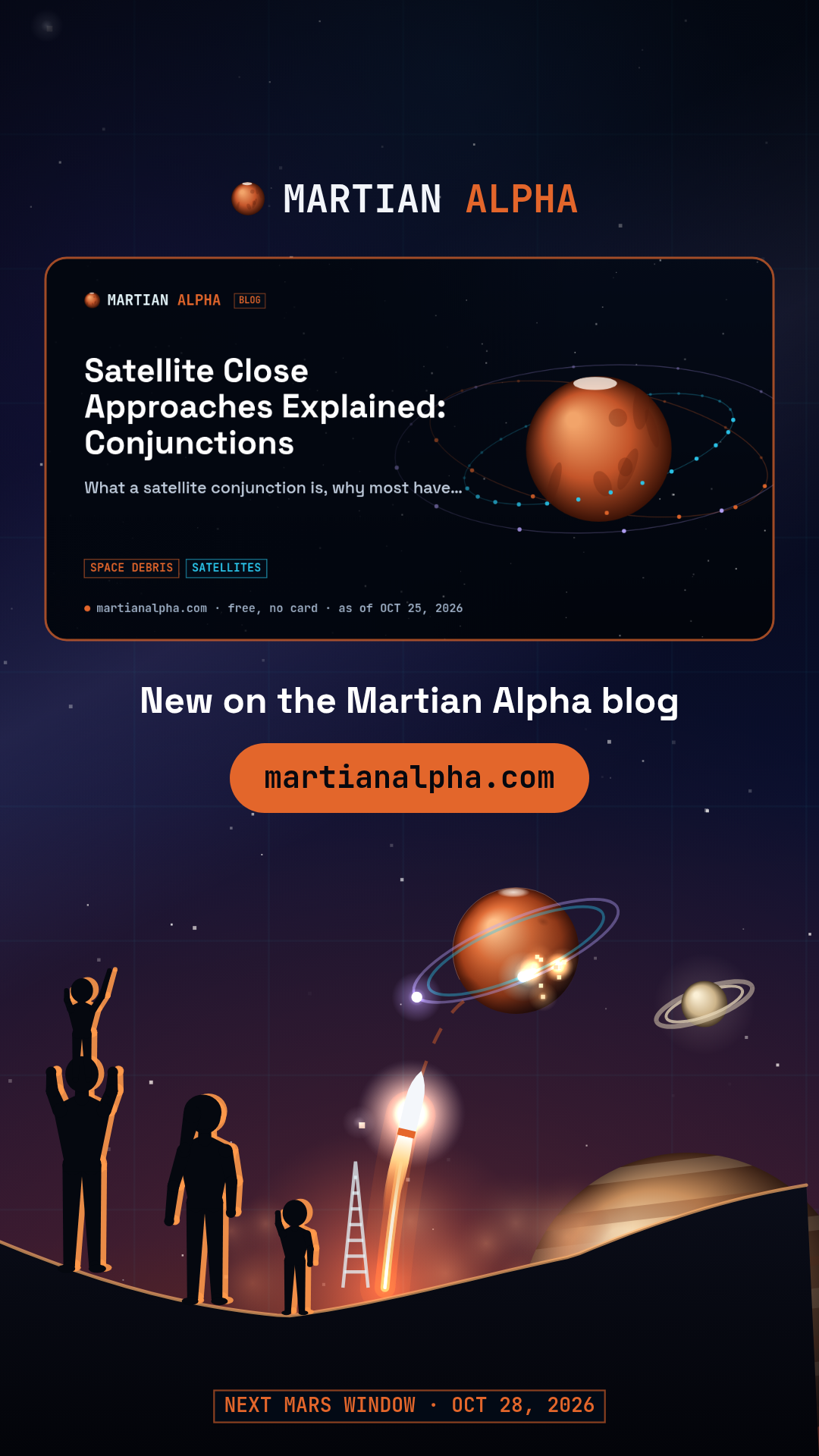
A satellite conjunction is a predicted close approach between two objects in orbit. Public screening services list them for the coming week, usually for passes within a few kilometres, together with a maximum collision probability. Most are harmless: the ISS only maneuvers, NASA says, when the chance of a collision exceeds 1 in 10,000, which happens about once a year on average. But the numbers are large because orbits are crowded: NASA counts more than 25,000 tracked objects bigger than 10 cm, and average impact speeds near 10 km/s.
What a conjunction is#
Two objects are in conjunction when their predicted paths bring them close together at a particular moment, called the time of closest approach (TCA). The prediction uses published orbital elements and a propagation model, so it carries uncertainty. A conjunction is not a collision; it's a warning that the geometry deserves a closer look.
CelesTrak's SOCRATES service, which has run since May 2004, is a public example. Three times a day it screens all active satellites against the full catalog of unclassified element sets for conjunctions over the next seven days, looking for passes within 5 km at TCA. For each one it reports the minimum distance and a maximum probability.
Why "maximum probability" is conservative#
CelesTrak explains that using minimum distance alone ignores position uncertainty and can exaggerate the true risk, so it favours a maximum-probability method that is more reasonable, though, in its words, still conservative. The practical lesson: a public list with a scary-looking number is usually a worst-case estimate from imprecise data. Operators use their own, more precise tracking data before deciding to maneuver.
How crowded is orbit?#
NASA's Orbital Debris Program Office FAQ gives the scale:
- More than 25,000 objects larger than 10 cm are known; about 500,000 particles are between 1 and 10 cm; more than 100 million exceed 1 mm. The material in orbit exceeded 9,000 metric tons as of January 2022.
- In low Earth orbit, debris circles at about 7 to 8 km/s. The average impact speed between objects is about 10 km/s and can reach about 15 km/s, so even small pieces carry considerable energy.
- The greatest concentration of debris is near 750 to 1,000 km altitude.
- Two events, China's 2007 destruction of the Fengyun-1C weather satellite and the 2009 collision of the Iridium-33 and Cosmos-2251 satellites, account for one-third of all cataloged orbital debris.
- Debris below 600 km normally falls back within several years; at 800 km, decay takes centuries; above 1,000 km it can stay up for a thousand years or more.
When do operators move?#
NASA says the US Space Surveillance Network regularly checks trajectories, and the ISS normally maneuvers away from an object projected to come within a few kilometres if the chance of collision exceeds 1 in 10,000. NASA adds that this occurs infrequently, about once a year on average. The 2009 Iridium-Cosmos collision, NASA says, was the worst accidental collision of two large objects.
Large constellations change the counts#
CelesTrak's SOCRATES notes that with the growth of Starlink and OneWeb, the overwhelming majority of reported conjunctions were between a constellation's own satellites. In its March 2, 2023 example, dropping intra-fleet screening cut the total from 143,997 to 56,343 conjunctions, because an operator has a much better view of its own fleet than public element sets can give. That date is old, and constellation sizes have grown since, so treat those numbers as an illustration of the method, not of today's totals. For the constellation side of the story, see our guides to how many Starlink satellites are in orbit and what investors should track in satellite constellations.
Why investors watch this#
Manoeuvres use fuel and interrupt service, so an operator that must move often spends satellite lifetime. Our constellations guide covers the licensing side. Counts of conjunctions are not a financial metric on their own, but they help you ask the right questions about an operator's disposal plans and fleet design.
Try it on Martian Alpha#
Martian Alpha's Collision & Debris Monitor lists predicted close approaches between satellites and space debris over the next week, taken from public conjunction screening, scored for risk on a 0 to 100 scale and grouped by operator. The page flags a probability of 1 in 1,000 as high; that's the monitor's own threshold, not an operator standard. The free plan shows the top close approaches today; watchlists, alerts and the full 7-day list are part of the Space Entrepreneur plan ($50 a month), and exports and API access are on Space Business ($100); see the plans page. It's for situational awareness: use CelesTrak and the operators' own notices for authoritative data.
The free quarterly State of Space Equities report includes close approaches per day by operator, from a daily record kept by Martian Alpha, and the collision monitor shows today's riskiest approaches.
FAQ#
What is a satellite conjunction?#
A predicted close approach between two objects in orbit at a specific time of closest approach. It's a screening result, not a collision.
How likely is a satellite collision?#
Most predicted close approaches are very unlikely to become collisions. Public lists use conservative maximum probabilities, and operators act on more precise data.
How often does the ISS move to avoid debris?#
NASA says it maneuvers when the collision chance exceeds 1 in 10,000, which happens about once a year on average.
How much debris is in orbit?#
NASA says more than 25,000 objects larger than 10 cm are tracked, about 500,000 are between 1 and 10 cm, and over 100 million are larger than 1 mm.
Where can I see conjunction data myself?#
CelesTrak's SOCRATES publishes weekly conjunction reports for free. Martian Alpha's monitor shows a summary by operator.
Is this investment advice?#
No. It explains how to read orbital safety data and isn't a recommendation about any security.
Sources#
- CelesTrak, SOCRATES Plus: https://celestrak.org/SOCRATES/
- NASA Orbital Debris Program Office, Frequently Asked Questions: https://orbitaldebris.jsc.nasa.gov/faq/
This article is for information only and is not financial advice. Do your own research before making any investment.