 Martian Alpha
 Amazon Leo vs Its FCC Deadlines: What the Waiver Means
Amazon Leo had 396 satellites up when its 1,616 FCC milestone passed. What the June 2026 waiver changed, what it costs, and the launch pace now needed.
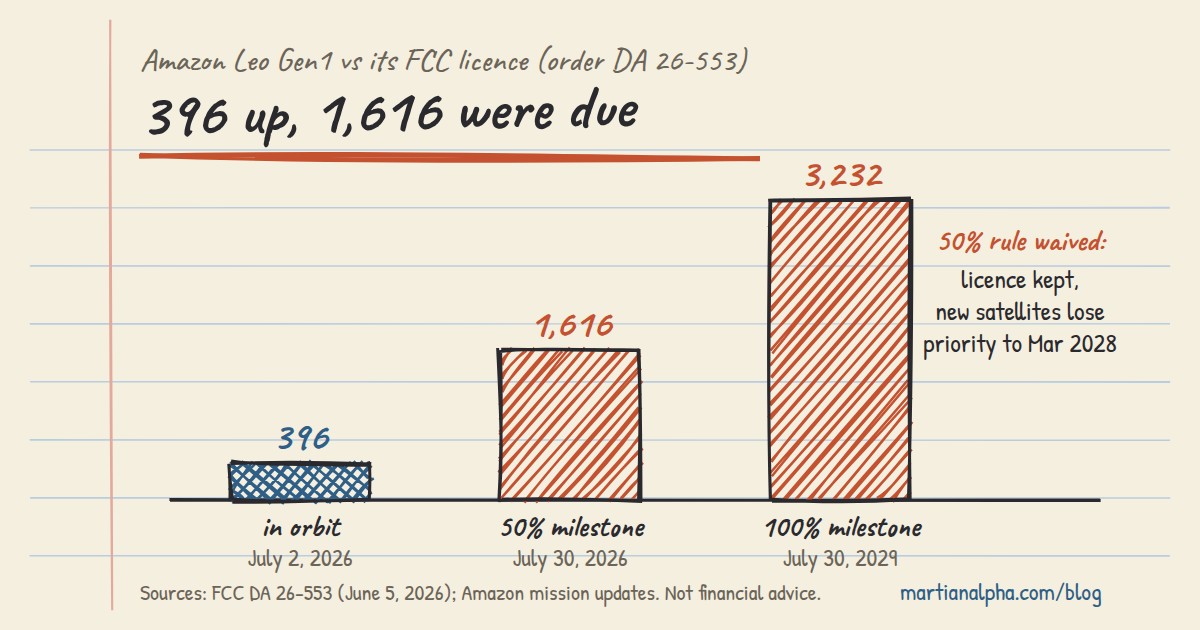
Amazon Leo, the satellite broadband network formerly called Project Kuiper, was required by its FCC licence to have 1,616 satellites in orbit by July 30, 2026. It had 396. Instead of shrinking the licence, the FCC granted a conditional waiver on June 5, 2026: Amazon keeps its authorization, but satellites launched after July 30, 2026 lose their spectrum priority until March 30, 2028 or until half the constellation is up, whichever comes first. The final deadline, all 3,232 satellites by July 30, 2029, didn't change.
The rule: FCC deployment milestones#
Under the FCC's rules for non-geostationary satellite systems (47 CFR 25.164(b)), a licensee must launch and operate 50% of its authorized constellation within six years of the licence grant and 100% within nine years. If it misses the halfway mark, its authorization is normally cut to the number of satellites in orbit on the deadline, and it must also have met the 50% milestone to meet the 100% one.
For Amazon's first-generation ("Gen1") system, the FCC's June 2026 order spells out the numbers:
| Milestone | Satellites | Deadline |
|---|---|---|
| 50% of Gen1 | 1,616 | July 30, 2026 |
| 100% of Gen1 | 3,232 | July 30, 2029 |
You'll often see 3,236 quoted for Amazon's constellation; the figure in the FCC order is 3,232.
What Amazon asked for, and what it got#
In a January 2026 filing, Amazon told the FCC it had launched 180 satellites and expected about 700 by July 30, 2026. It asked the Commission to move the 50% deadline to July 30, 2028, or alternatively to waive the rule so it could keep its authorization for the satellites not yet launched. SpaceX filed comments in the proceeding.
The FCC's Space Bureau did neither exactly. On June 5, 2026 it granted a limited waiver with conditions, calling that "a better and more efficient approach" than an extension:
- The licence survives. Amazon isn't cut down to the number of satellites in orbit on July 30, 2026, and the 2029 deadline for all 3,232 still applies.
- Satellites launched late lose priority. Any Gen1 satellite not deployed and operating by July 30, 2026 temporarily loses the "earlier-round" processing priority Amazon won in the FCC's 2020 Ku/Ka-band and 2021 V-band rounds, and is moved to a later priority status.
- The penalty has an end date. Priority comes back on the earlier of March 30, 2028 (20 months after the milestone) or the date Amazon has 50% of the constellation deployed and operating.
- It can be shortened. If Amazon certifies that it has built all the satellites it needs for 50% and has bought enough launches to deploy them, the 20 months drop to 15, ending October 30, 2027.
In practice, spectrum priority decides whose system has to give way when two non-geostationary networks would interfere with each other. For the satellites Amazon launches between now and 2028, it now ranks behind systems it used to outrank.
Where deployment stands#
| Date | Event | Source |
|---|---|---|
| Jan 2026 | Amazon files for an extension or waiver (ICFS SAT-MOD-20260129-00065); 180 satellites launched | FCC order |
| May 28, 2026 | New Glenn, one of Amazon's planned launch vehicles, explodes during a ground test; no Amazon satellites aboard | Reuters, Spaceflight Now |
| June 5, 2026 | FCC grants the conditional waiver | FCC DA 26-553 |
| July 2, 2026 | Atlas V launch LA-08 with 29 satellites brings the total to 396 | Amazon mission updates |
| July 30, 2026 | 50% milestone date passes (1,616 required) | FCC order |
| Sept 9, 2026 | Amazon orders six more Ariane 64 launches, 24 in total | Arianespace |
In 2026 Amazon flew on two rockets: Atlas V (29 satellites per launch) and Ariane 64 (32 to 36). Arianespace says it put 100 Amazon Leo satellites into orbit on three Ariane 6 missions in under five months. As of early October 2026, there had been no further Amazon Leo launch after July 2, according to Amazon's mission page and the list of Amazon Leo launches; The Verge reported the gap on September 28.
The launch pace the deadlines now imply#
Simple arithmetic shows the size of the task (our calculation, at 29 to 36 satellites per launch, the payloads Amazon has flown so far):
| Target | Satellites still needed (from 396) | Launches at 29-36 per launch |
|---|---|---|
| 50% (1,616): ends the priority penalty early | 1,220 | about 34 to 43 |
| 100% (3,232) by July 30, 2029 | 2,836 | about 79 to 98 |
Bigger rockets change the math. Amazon has said it plans to fly larger batches on Vulcan Centaur and New Glenn, and every satellite added per launch cuts the count. But the two rockets that delivered all of 2026's satellites carry the smaller loads, and New Glenn was destroyed in a ground-test explosion in May; Blue Origin traced the cause to an oxygen valve on a BE-4 engine.
For the priority penalty, the relevant dates are October 30, 2027 (if Amazon certifies early) and March 30, 2028. For the licence itself, it's July 30, 2029.
What this means for investors#
This isn't a recommendation on any stock. It's a list of where the milestone story shows up:
- Amazon (AMZN): Leo is a small part of a very large company, so deployment delays matter more for the project's timeline and spending than for the share price. Watch Amazon's mission updates and any FCC filings, especially a certification that would start the 15-month clock.
- Launch providers: Amazon has booked 24 Ariane 64 launches with Arianespace (whose parent ArianeGroup is a joint venture of Airbus and Safran) and flies on United Launch Alliance's Atlas V, with Vulcan launches planned (ULA is a Boeing and Lockheed Martin joint venture). The cadence of those missions is the most visible indicator of progress. Blue Origin is private.
- Competitors: a slower Amazon rollout matters most for Starlink, owned by SpaceX (SPCX), the incumbent in consumer satellite broadband.
- Regulatory signal: the order shows the FCC is willing to keep a licence alive and attach a cost instead. That precedent matters for any constellation that falls behind its milestones.
Tracking it on Martian Alpha#
Martian Alpha's free launch calendar lists upcoming missions worldwide, including Amazon Leo launches as they're scheduled, and the catalyst feed tags regulatory filings and launch results for listed space companies. To compare deployment pace with other networks, our guide to satellite constellations covers what to track, and why satellite counts differ between trackers explains how to read launched, in-orbit and working numbers.
FAQ#
Did Amazon Leo miss its FCC deadline?#
Yes. The licence required 1,616 Gen1 satellites by July 30, 2026, and Amazon had 396 in orbit. But the FCC granted a conditional waiver on June 5, 2026, so Amazon kept its authorization instead of having it cut to the number of satellites in orbit.
What penalty did the FCC impose?#
Satellites not deployed and operating by July 30, 2026 lose their earlier-round spectrum priority until March 30, 2028, or until Amazon reaches 50% deployment, whichever comes first. Amazon can shorten that to October 30, 2027 by certifying it has built enough satellites and secured enough launches to reach 50%.
How many satellites does Amazon Leo need in total?#
3,232 Gen1 satellites by July 30, 2029, according to the FCC's June 2026 order. That final deadline wasn't changed.
How many Amazon Leo satellites are in orbit?#
396 after the July 2, 2026 Atlas V launch, according to Amazon. There had been no further Amazon Leo launch as of early October 2026. Independent trackers that count only operating satellites show slightly lower figures.
Why does spectrum priority matter?#
When two satellite networks would interfere, the one with earlier processing-round priority generally gets protection and the later one has to adjust. Losing priority for new satellites doesn't stop Amazon operating them, but it weakens its position in coordination with other systems until priority is restored.
Sources#
- FCC Space Bureau, Order DA 26-553, Kuiper Systems LLC, adopted and released June 5, 2026
- Amazon: Amazon Leo mission updates
- Arianespace: Amazon Leo orders six additional Ariane 64 launches, September 9, 2026
- Wikipedia: List of Amazon Leo launches (checked 2026-10-04)
- Reuters: Blue Origin rocket explodes on launchpad, May 29, 2026 and Spaceflight Now: Blue Origin identifies engine issue, August 6, 2026
- The Verge: SpaceX preps next-gen Starlink as Amazon's competitor stalls, September 28, 2026
- Ars Technica: FCC lifts looming deadline for Amazon Leo, June 2026
This article is for information only and is not financial advice. Do your own research before making any investment.