 Martian Alpha
 What Is Amazon Leo? Service, Terminals and Coverage in 2026
Amazon Leo, formerly Project Kuiper, explained: how the network works, the Nano, Pro and Ultra terminals, who has signed up, and when service starts.
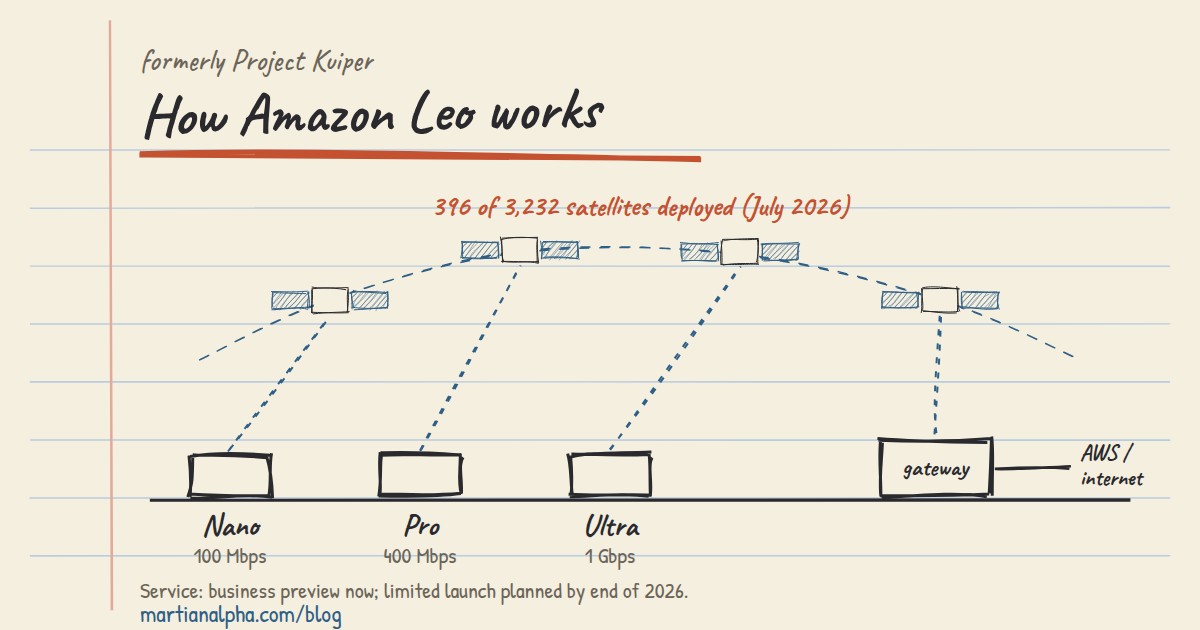
Amazon Leo is Amazon's low Earth orbit satellite internet network, called Project Kuiper until November 2025. It is licensed for 3,232 first-generation satellites, had deployed 396 by July 2026, and is in a preview with selected business customers; Amazon says limited commercial service will start by the end of 2026 in mid-northern and mid-southern latitudes, expanding toward the equator as more satellites go up. It sells through three terminals, Nano (up to 100 Mbps), Pro (up to 400 Mbps) and Ultra (up to 1 Gbps), and hasn't published prices.
How Amazon Leo works#
Like Starlink, Amazon Leo uses many satellites a few hundred kilometers up instead of a few large satellites in geostationary orbit 35,786 km away. The shorter distance cuts latency, the delay that makes video calls and gaming awkward over older satellite services. The trade-off is that each satellite is overhead for only a few minutes, so a network needs hundreds or thousands of them for continuous coverage. Our guide to LEO vs GEO satellites covers the trade-offs in more detail.
The system has three parts, as Amazon describes it:
- Satellites, an initial constellation of more than 3,000. The FCC licence covers 3,232 in the first generation.
- Ground gateways and fiber, a network of gateway antennas that connect the satellites to the internet. Business customers can also connect directly to Amazon Web Services (AWS) or their own private networks without crossing the public internet.
- Customer terminals, the flat antennas customers install.
Coverage starts where the satellites are densest. Because of the orbits Amazon chose, that's the mid-latitude bands of the northern and southern hemispheres, not the equator. Chris Weber, who runs Amazon Leo's business and product side, told GeekWire in May 2026 that service would launch "in the northern and southern hemisphere" first, and that coverage would "expand inward geographically" as more satellites go up.
The three terminals#
Amazon announced the terminal line-up in November 2025, when it renamed Project Kuiper and began an enterprise preview:
| Terminal | Antenna | Download speed (up to) | Upload speed (up to) | Notes |
|---|---|---|---|---|
| Leo Nano | Compact, 7-inch | 100 Mbps | not stated | Smallest terminal |
| Leo Pro | Standard, 11-inch | 400 Mbps | not stated | Shipped in the enterprise preview |
| Leo Ultra | About 20 x 30 inch phased array | 1 Gbps | 400 Mbps | Enterprise-grade, for fixed sites |
Nano and Pro sizes and speeds are from GeekWire's report on the announcement, the Ultra speeds are from Amazon, and the Ultra's size is from Tom's Hardware. Amazon also has an aviation antenna rated at up to 1 Gbps down and 400 Mbps up. Prices for terminals and service plans hadn't been published as of October 2026. "Up to" speeds are maximums, so expect real speeds to depend on location, network load and how many satellites are in view.
Is Amazon Leo available yet?#
Not to the general public. The timeline so far:
| Date | Status | Source |
|---|---|---|
| November 2025 | Project Kuiper renamed Amazon Leo; enterprise preview begins with Pro and Ultra units shipped to selected companies | Amazon |
| May 2026 | 304 satellites deployed over 11 launches; Weber says commercial launch is coming "in the coming months — so it's not years away", and Amazon plans to double its launch pace over the next 12 months | GeekWire |
| July 2026 | 396 satellites deployed after the last Atlas V mission on July 2; Weber says that's enough for continuous service across the initial latitudes | Light Reading |
| September 2026 | Amazon still plans limited commercial service by the end of 2026, despite launch vehicle problems slowing deployment | SpaceNews |
The target has slipped once: Amazon CEO Andy Jassy said in May 2026 that Leo was aiming for a "mid-2026" service launch, and by July the company was saying "later this year". Launches have also paused. As of early October 2026 there had been no Amazon Leo launch since July 2: Atlas V has finished its Amazon missions, and the next ones depend on Vulcan and Ariane 6. Our post on Amazon Leo's FCC deadlines covers what that means for its licence and the launch pace it now needs.
Who has signed up#
Amazon Leo has started with businesses, governments and distribution partners rather than individual households:
- Airlines. JetBlue was one of the first named customers in 2025. Delta agreed in March 2026 to install Amazon Leo on 500 aircraft, starting in 2028.
- Telecoms carriers. Amazon Leo's announced partners include Verizon, Vodafone and Vodacom, and NBN Co, which runs Australia's national broadband network, was named as a customer in November 2025. In September 2026, AT&T Business signed an agreement to add Amazon Leo to its fiber and 5G offering for public sector and enterprise customers, and Uztelecom's UZ-SAT became an authorized distributor in Uzbekistan.
- Other enterprise customers. Energy, agriculture and connectivity companies including Hunt Energy Network, Connected Farms and Vanu were named as customers and partners when the preview began.
Amazon Leo vs Starlink#
| Amazon Leo | Starlink | |
|---|---|---|
| Owner | Amazon (AMZN) | SpaceX (SPCX) |
| Satellites deployed | 396 (July 2026) | More than 10,000 in orbit |
| Commercial service | Preview only; limited launch planned by end of 2026 | Available in many countries |
| Subscribers | Not reported | 12.0 million at June 30, 2026 |
| Launch | Atlas V (finished), Vulcan, Ariane 6, others booked | SpaceX's own Falcon 9 and Starship |
The Starlink subscriber figure is from SpaceX's Q2 2026 results, and it counts only self-serve service lines, not airline or government contracts. Our SpaceX earnings guide explains that definition, and how many Starlink satellites are in orbit covers the satellite count.
The biggest difference is launch. SpaceX launches Starlink on its own rockets; Amazon has to buy launches from others, and in 2026 several of those rockets were delayed or grounded. That's why Amazon Leo's progress tracks the launch schedule more closely than Starlink's does.
What it means for investors#
Amazon Leo isn't a separate stock. It sits inside Amazon, so its progress shows up in Amazon's announcements and FCC filings rather than in its own earnings. The listed companies most exposed are the launch providers' parents (ULA is a Boeing and Lockheed Martin joint venture; Arianespace's parent is owned by Airbus and Safran) and, on the competitive side, SpaceX. This is a guide to what Amazon Leo is, not investment advice or a recommendation to buy or sell any security.
Tracking Amazon Leo in Martian Alpha#
Martian Alpha's free Constellation Tracker shows Amazon Leo's satellites launched against its 3,232-satellite first-generation plan, next to Starlink, OneWeb and other networks. The launch calendar lists upcoming Amazon Leo missions once they're scheduled, and the Catalyst Feed tags FCC and launch news for listed space companies.
FAQ#
What is Amazon Leo?#
Amazon Leo is Amazon's satellite internet network, previously called Project Kuiper. It uses satellites in low Earth orbit to provide broadband to homes, businesses, governments, airlines and mobile carriers. It's licensed for 3,232 first-generation satellites.
Is Amazon Leo the same as Project Kuiper?#
Yes. Amazon renamed Project Kuiper to Amazon Leo in November 2025, when it also announced its Ultra terminal and an enterprise preview program. Older articles and FCC filings still use "Kuiper".
When will Amazon Leo be available?#
Amazon plans limited commercial service by the end of 2026, starting in mid-northern and mid-southern latitudes and expanding toward the equator as more satellites launch. Selected business customers have been using it in a preview since late 2025.
How fast is Amazon Leo?#
Amazon quotes download speeds of up to 100 Mbps for Leo Nano, 400 Mbps for Leo Pro and 1 Gbps for Leo Ultra, which also uploads at up to 400 Mbps. These are maximums; real speeds will vary with location and network load.
How much does Amazon Leo cost?#
Amazon hadn't published terminal or service prices as of October 2026. Check Amazon Leo's own site for pricing when consumer service launches.
Sources#
- Amazon: Amazon Leo debuts Ultra antenna, begins enterprise preview (November 2025)
- GeekWire: Amazon Leo Ultra and service tiers (November 2025) and Amazon Leo plans to double its pace (May 14, 2026)
- Light Reading: Amazon Leo inches toward service launch (July 6, 2026)
- SpaceNews: Amazon Leo planning to begin initial services by end of the year (September 10, 2026)
- Delta News Hub: Delta and Amazon Leo agreement (March 31, 2026)
- ExecutiveBiz: AT&T Business and Amazon Leo agreement (September 14, 2026)
- Amazon: Amazon Leo and Uztelecom (September 2026)
- FCC Space Bureau order DA 26-553 on Amazon's Gen1 milestones (June 5, 2026)
- SpaceX second-quarter 2026 results (SEC)
This article is for information only and is not financial advice. Do your own research before making any investment.