 Martian Alpha
 SpaceX Earnings Explained: How to Read SPCX's Results
SpaceX reports three segments: Space, Connectivity and AI. What each one earns and spends, which metrics matter, and what to check in SPCX's Q3 report.
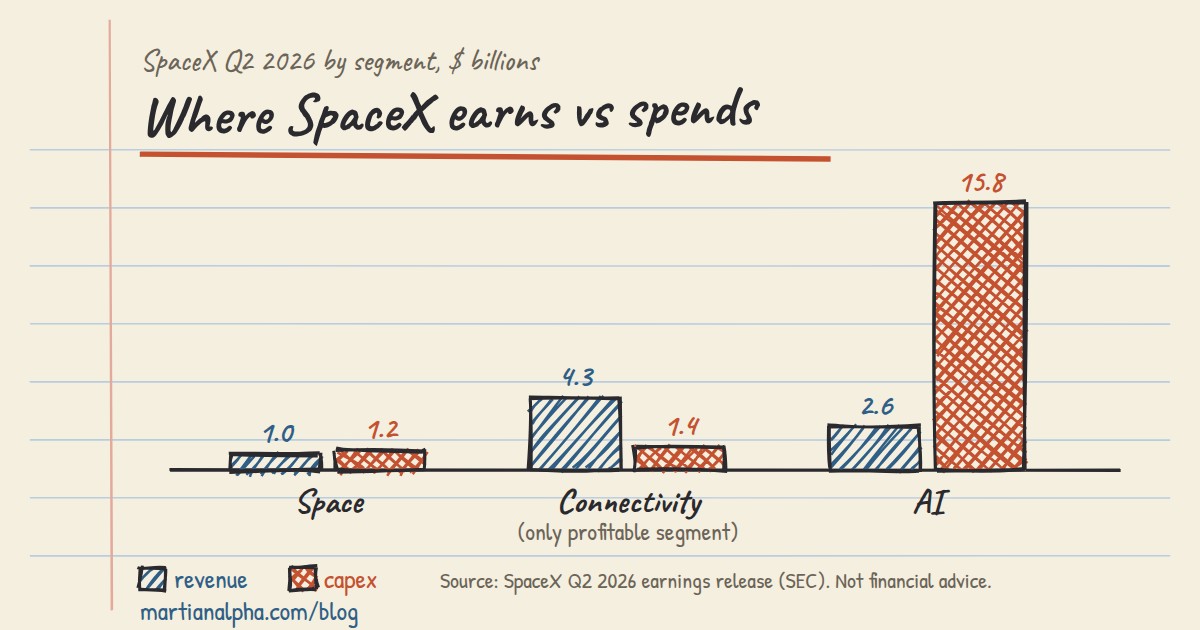
SpaceX (Nasdaq: SPCX) reports results in three segments: Space (rockets), Connectivity (Starlink and Starshield) and AI (Grok, X and data-center compute). In its first report as a public company, for the second quarter of 2026, revenue was $7.8 billion: $4.3 billion from Connectivity, $2.6 billion from AI and $962 million from Space. Only Connectivity made an operating profit, and AI accounted for $15.8 billion of the $18.4 billion in capital spending. The third-quarter results date hadn't been announced as of October 5, 2026.
Where the numbers come from#
SpaceX files two documents each quarter, and they serve different purposes:
- The earnings release, filed with the SEC as an exhibit to an 8-K and posted on ir.spacex.com. It has the segment tables, the operating metrics (launches, Starlink subscribers, compute capacity) and management's highlights. The Q2 2026 release is ten pages.
- The 10-Q, the full quarterly report. It has the definitions behind each metric, the risk factors and the notes on debt, backlog and acquisitions. The Q2 2026 10-Q was filed on August 4, 2026, the same day as the release.
Read the release for the numbers and the 10-Q for what the numbers mean. Several of SpaceX's metrics have narrower definitions than their names suggest.
The three segments at a glance#
All figures in millions of US dollars, from the Q2 2026 earnings release:
| Segment | Revenue Q2 2025 | Revenue Q1 2026 | Revenue Q2 2026 | Operating income Q2 2026 | Capex Q2 2026 |
|---|---|---|---|---|---|
| Space | 746 | 619 | 962 | (542) | 1,174 |
| Connectivity | 2,588 | 3,257 | 4,291 | 1,656 | 1,367 |
| AI | 737 | 818 | 2,561 | (1,257) | 15,828 |
| Total | 4,071 | 4,694 | 7,814 | (143) | 18,369 |
Three things stand out. Connectivity is 55% of revenue and the only profitable segment. AI revenue more than tripled in one quarter. And AI took 86% of capital spending.
Space: launches, mass to orbit and Starship#
The Space segment earns money two ways: launch services (Falcon 9 and Falcon Heavy flights for commercial and government customers) and launch and development work for government programs. Its key metrics are in a separate table:
| Space metric | Q2 2025 | Q1 2026 | Q2 2026 |
|---|---|---|---|
| Customer launches | 9 | 7 | 10 |
| Internal launches | 37 | 33 | 28 |
| Mass to orbit (metric tons) | 652 | 556 | 485 |
| Launch services revenue ($M) | 490 | 330 | 648 |
| Research and development ($M) | 693 | 930 | 1,076 |
How to read it:
- Only customer launches earn launch revenue. Internal launches, mostly Starlink, are a cost of building the Connectivity business. Revenue rose in Q2 because there were more large customer launches, even though the total launch count fell.
- Starship is counted as internal. The 10-Q says that "to date, all Starship launches have been classified as internal", so Starship doesn't add to launch revenue yet. Its cost shows up in Space R&D, which drove the segment's $542 million operating loss.
- Check the count against a tracker. Launch trackers count 35 SpaceX launches in Q3 2026, down from 38 in Q2. Our guide to reading the SpaceX launch schedule explains where those numbers come from and why Florida Starlink launches stopped.
Connectivity: subscribers, ARPU and enterprise#
Connectivity is Starlink broadband, Starlink Mobile (direct-to-cell service sold through carriers) and Starshield, the government version of the network.
| Connectivity metric | Q2 2025 | Q1 2026 | Q2 2026 |
|---|---|---|---|
| Starlink subscribers (millions, period end) | 6.0 | 10.3 | 12.0 |
| Starlink ARPU ($ per month) | 85 | 66 | 66 |
| Consumer revenue ($M) | 1,721 | 2,148 | 2,485 |
| Enterprise & government revenue ($M) | 867 | 1,109 | 1,806 |
Two definitions in the 10-Q change how you read these:
- A "subscriber" is a service line, not a person, and only lines on a Starlink.com account without a negotiated agreement with Starlink's sales team count. Airlines, maritime fleets, governments and other negotiated contracts aren't in the 12.0 million, so their revenue sits in Enterprise & Government instead.
- ARPU is service revenue only, divided by average subscribers and by months. It fell from $85 to $66 over the year as subscribers doubled, so the subscriber count grew faster than the revenue per line.
Enterprise & Government revenue includes Starlink Mobile, and it grew fastest: up 108% year over year. SpaceX said it was awarded over $6 billion in multi-year Starshield contracts in the quarter, mostly from two Space Force programs. For how satellite counts relate to the network, see why Starlink satellite counts differ between trackers.
AI: compute, contracted sales and capex#
The AI segment covers Grok, X advertising and subscriptions, and selling data-center compute to other companies.
| AI metric | Q2 2025 | Q1 2026 | Q2 2026 |
|---|---|---|---|
| Nameplate compute (GW) | 0.4 | 1.0 | 1.4 |
| Advertising revenue ($M) | 426 | 343 | 367 |
| AI solutions & infrastructure revenue ($M) | 311 | 475 | 2,194 |
| AI capex ($M) | 749 | 7,723 | 15,828 |
The jump in AI revenue came from Cloud Services Agreements: SpaceX signed $14.1 billion in "contracted sales", which produced $1.6 billion of extra infrastructure revenue in Q2. Again, the definitions matter:
- Contracted sales count only the non-cancellable, enforceable part of a contract. Amounts the customer or SpaceX can cancel aren't included.
- Nameplate compute is installed GPUs multiplied by their power draw. The 10-Q says it "does not represent actual power consumption or utilization".
AI also produced positive segment adjusted EBITDA ($1.1 billion), after losses on that measure in Q1 2026 and Q2 2025, while still posting a $1.3 billion operating loss, mostly because of $1.9 billion of depreciation and amortization, largely on its data centers. In August, SpaceX completed its $60 billion acquisition of Cursor, the AI coding company (Cursor, August 14, 2026), so Q3 is the first quarter that includes it.
Net loss vs adjusted EBITDA#
SpaceX reported a Q2 net loss of $541 million and adjusted EBITDA of $3.5 billion. The $4.1 billion gap is mostly two items the adjusted figure leaves out:
- Depreciation and amortization: $2.8 billion, two-thirds of it in AI. Data centers and satellites wear out, so this is a real cost, just not a cash one in the quarter.
- Share-based compensation: $831 million, paid in stock instead of cash, which dilutes shareholders.
SpaceX defines both measures in the release and reconciles them. Neither is wrong, but they answer different questions: adjusted EBITDA shows operating cash generation before investment, and net loss shows whether the business covers the cost of what it has built.
Per-share numbers need care too. Q2's loss of $0.09 per share used a weighted average of 5.9 billion shares, because the IPO and the conversion of preferred stock happened late in the quarter. At June 30 there were about 13.2 billion shares outstanding (7.6 billion Class A, 5.6 billion Class B). Q3 is the first full quarter at that share count. Our guide to reading a space company's S-1 covers the share classes and voting control.
Cash, debt and backlog#
| Item (June 30, 2026) | Amount | Source |
|---|---|---|
| Cash, equivalents and marketable securities | $100.0 billion ($93.5B + $6.5B) | Balance sheet |
| Debt and finance leases | $39.4 billion ($2.5B current + $36.8B long-term) | Balance sheet |
| of which owed to related parties | $13.3 billion | Balance sheet |
| Backlog | $47.5 billion | Release, CFO commentary |
| Deferred revenue | $14.3 billion | 10-Q |
| Operating cash flow, first half of 2026 | $3.5 billion | Cash flow |
| Capex, first half of 2026 | $28.5 billion | Segment table |
Most of the cash came from the IPO (about $85.7 billion in net proceeds, closed June 15) and a $25 billion bond issue on June 26 with coupons from 5.35% to 6.65%. Operating cash flow in the first half covered about an eighth of capital spending. That's the number to watch: whether the cash pile shrinks as compute spending continues. The 10-Q's debt note explains the related-party borrowing.
What to check in the Q3 report#
- The date. SpaceX hadn't announced it as of October 5. It matters beyond earnings: up to 1.3 billion shares are released from the IPO lock-up on the second full trading day after Q3 results, as our space IPO lock-up calendar explains.
- Customer launches and launch services revenue. Did more customer missions offset fewer internal ones?
- Subscribers and ARPU together. Growth with a stable ARPU is a different story from growth with a falling one.
- AI capex and compute. Compare the next nameplate compute figure with Q2's 1.4 GW and the capex spent to get there.
- Contracted sales. New Cloud Services Agreements, and how much of the $14.1 billion turned into revenue.
- Cursor. The first quarter with the acquisition included; look for revenue and amortization of acquired intangibles in the AI segment.
- Per-share figures on a full quarter of about 13.2 billion shares.
This is a guide to reading the filings, not a view on the stock. It isn't financial advice or a recommendation to buy or sell SPCX.
Following SpaceX in Martian Alpha#
The free SPCX company page collects SpaceX's price, recent news and catalysts, and launches it flew, and the Catalyst Feed tags earnings, filings, contract awards and launches for 70+ space stocks. To put SpaceX's numbers next to other space companies, use Compare. With a free account you can also ask Earnings Q&A (3 questions a day) about an earnings transcript and run an AI Deep Dive on the company (2 a week); the Earnings Calendar with post-earnings price moves is part of the Space Professional plan.
FAQ#
When does SpaceX report third-quarter 2026 earnings?#
SpaceX hadn't announced the date as of October 5, 2026. It reported Q2 results on August 4, 2026, with a webcast at 4:30 p.m. ET. Some calendars estimate early November, but the confirmed date will appear on ir.spacex.com.
What are SpaceX's business segments?#
Three: Space (Falcon 9 and Falcon Heavy launches, government launch and development work, and Starship), Connectivity (Starlink broadband, Starlink Mobile and Starshield) and AI (Grok, X and data-center compute). In Q2 2026 they brought in $962 million, $4.3 billion and $2.6 billion of revenue.
How many Starlink subscribers does SpaceX have?#
12.0 million at June 30, 2026, double a year earlier, at an average of $66 a month. SpaceX counts service lines on Starlink.com accounts, so customers with negotiated contracts, such as airlines and governments, aren't included in that number.
Is SpaceX profitable?#
Not on a net basis yet. It lost $541 million in Q2 2026 and $4.8 billion in the first half, but reported $3.5 billion of adjusted EBITDA in Q2. Connectivity made a $1.7 billion operating profit; Space and AI made operating losses.
What is SpaceX's backlog?#
$47.5 billion at June 30, 2026, according to the Q2 release. Backlog is the contract value of work not yet performed, so it isn't revenue yet, and the 10-Q explains what's included.
Sources#
- SpaceX second-quarter 2026 results (earnings release, exhibit to 8-K, filed August 4, 2026)
- SpaceX Form 10-Q for the quarter ended June 30, 2026: key business metrics, revenue, deferred revenue and backlog notes
- SpaceX investor relations: financials
- SpaceX final prospectus (424B4), June 2026: lock-up release schedule
- Cursor: "Cursor is now a part of SpaceX", August 14, 2026 and TechCrunch, August 15, 2026
This article is for information only and is not financial advice. Do your own research before making any investment.