 Martian Alpha
 Rocket Equation and Delta-v: Worked Examples
The rocket equation worked step by step: delta-v from specific impulse, why 94% of a rocket is propellant, staging, and LEO to GEO.
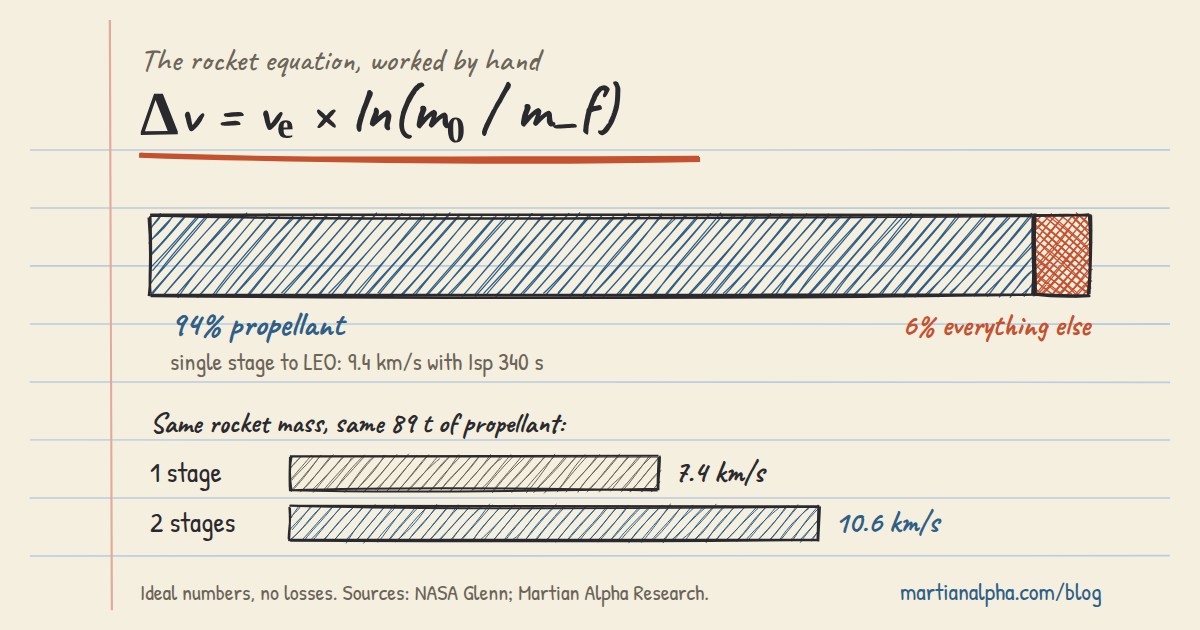
The rocket equation says a rocket's change in velocity (delta-v) equals its exhaust velocity times the natural log of its full mass divided by its empty mass: Δv = vₑ × ln(m₀ / m_f). Reaching low Earth orbit takes roughly 9.3 to 9.8 km/s of delta-v once gravity and drag losses are counted. With a good kerosene engine, that means about 94% of a single-stage rocket would have to be propellant, which is why real launchers use stages.
This guide works through the equation with real numbers, the way a student, engineer or curious investor would check it by hand. Every example can be reproduced in the free calculators on Martian Alpha's Engineering Toolkit.
The equation and its three inputs#
NASA Glenn Research Center derives the ideal rocket equation from conservation of momentum, ignoring gravity and drag during the burn:
Δv = vₑ × ln(m₀ / m_f)
- vₑ (effective exhaust velocity), in m/s. How fast the engine throws propellant out the back, on average. Engine data sheets usually give specific impulse (Isp) in seconds instead. Convert with vₑ = Isp × g₀, where g₀ = 9.80665 m/s².
- m₀ (initial mass). Everything at ignition: structure, engines, payload and all propellant.
- m_f (final mass). What is left when the burn ends: the same thing minus the propellant burned.
The ratio m₀/m_f is the mass ratio. Because it sits inside a logarithm, doubling the mass ratio does not double delta-v. That is the single most important fact about rockets.
Converting specific impulse to exhaust velocity#
| Specific impulse | Exhaust velocity (Isp × 9.80665) | Typical of |
|---|---|---|
| 300 s | 2,942 m/s | Solid motors, kerosene engines at sea level |
| 340 s | 3,334 m/s | Kerosene/oxygen engines in vacuum |
| 450 s | 4,413 m/s | Hydrogen/oxygen engines in vacuum |
The "typical of" column is a rough guide. For a specific engine, use the manufacturer's published Isp, and note whether it is the sea-level or vacuum figure.
Worked example 1: the toolkit's default rocket#
The Rocket Equation calculator opens with vₑ = 3,200 m/s, m₀ = 1,000 kg and m_f = 300 kg.
- Mass ratio: 1,000 / 300 = 3.33
- ln(3.33) = 1.204
- Δv = 3,200 × 1.204 = 3,853 m/s
So a vehicle that is 70% propellant by mass, with a decent engine, gets about 3.9 km/s. That is less than half of what orbit needs.
Worked example 2: why 94% of a rocket is propellant#
Turn the equation around to find the mass ratio a mission needs:
m₀ / m_f = e^(Δv / vₑ)
Take 9.4 km/s to reach low Earth orbit (the default in the toolkit's Delta-v Budget tab):
| Engine | vₑ | Mass ratio needed | Share of liftoff mass that is propellant |
|---|---|---|---|
| Kerosene, Isp 340 s | 3,334 m/s | e^(9,400/3,334) = 16.8 | 94.0% |
| Hydrogen, Isp 450 s | 4,413 m/s | e^(9,400/4,413) = 8.4 | 88.1% |
On a single-stage kerosene rocket, only 6% of the liftoff mass would be left for tanks, engines, avionics and payload. Better engines help, but hydrogen's low density means bigger, heavier tanks, so the gain is smaller than the table suggests. This is the "tyranny of the rocket equation".
Where the 9.3 to 9.8 km/s comes from#
Orbital velocity at 200 km is only about 7.8 km/s, so why budget more than 9 km/s? A Utah State University propulsion course works the numbers for a due-east launch from Kennedy Space Center to a 200 km orbit:
- Orbital speed: 7.784 km/s.
- Earth's rotation helps: at 28.5° latitude the ground is already moving east at about 0.408 km/s, so the rocket needs 7.738 km/s more.
- Climbing to altitude costs the equivalent of about 1.95 km/s.
- Combined, that is about 7.98 km/s before any losses.
On top of that come gravity losses (thrust spent holding the rocket up while it climbs), drag losses in the lower atmosphere and steering losses. These depend on the vehicle and its trajectory, and together they push the practical total to about 9.3 to 9.8 km/s (Wikipedia's delta-v budget article gives 7.8 km/s plus 1.5 to 2 km/s of losses, and about 9.4 km/s for a 300 km ISS-type orbit). Launching to a higher inclination than the launch site's latitude means less help from Earth's rotation, which is part of why polar and sun-synchronous launches carry less payload.
Worked example 3: why staging works#
Compare two 100-tonne rockets with the same engines (vₑ = 3,334 m/s), the same 89 tonnes of propellant and the same 1-tonne payload. No losses are counted, so these are ideal numbers.
Single stage: 100 t at liftoff, 11 t at burnout (10 t of structure plus 1 t of payload). Δv = 3,334 × ln(100 / 11) = 7,359 m/s. Not enough for orbit.
Two stages:
- The first stage burns 72 t of propellant. 100 t → 28 t. Δv = 3,334 × ln(100/28) = 4,244 m/s.
- It drops its 8 t of empty structure, leaving a 20 t upper stage.
- The upper stage burns 17 t. 20 t → 3 t (2 t of structure plus the payload). Δv = 3,334 × ln(20/3) = 6,325 m/s.
Total: 10,569 m/s, more than 3 km/s better than the single stage, with the same propellant. Dropping empty tanks mid-flight means the second burn doesn't have to accelerate dead weight. Every orbital launcher in service today uses at least two stages for this reason.
Worked example 4: LEO to GEO with a Hohmann transfer#
A Hohmann transfer is the minimum-energy two-burn move between two circular orbits in the same plane. NASA JPL's Basics of Space Flight explains the idea for interplanetary trips, and the same maths applies around Earth. Use the Hohmann Transfer calculator with its defaults: orbit 1 radius 6,678 km (300 km altitude) and orbit 2 radius 42,164 km (geostationary), with μ = 398,600 km³/s².
- Circular speed in the low orbit: √(μ/r₁) = 7.726 km/s
- First burn, to enter the transfer ellipse: 7.726 × (√(2r₂/(r₁+r₂)) − 1) = 2.426 km/s
- Second burn at GEO altitude, to circularise: 1.467 km/s
- Total: 3.893 km/s, with a coast of 18,990 seconds (about 5.3 hours) between burns
This assumes no plane change. A satellite launched from Florida starts in an orbit tilted about 28.5° to the equator and must also remove that tilt to become geostationary, which adds delta-v. This is why launch providers quote much lower payload to geostationary transfer orbit than to LEO: SpaceX lists Falcon 9 at 22,800 kg to LEO, 8,300 kg to GTO and 4,020 kg to Mars.
Quick reference: orbital period and speed#
For a circular orbit of radius r = Earth's radius + altitude:
- Speed: v = √(μ / r)
- Period: T = 2π × √(r³ / μ)
At 400 km altitude (about where the ISS flies), r = 6,778 km, giving 7.67 km/s and a period of 92.6 minutes. The Orbital Period tool does this for any altitude (free account).
Common mistakes#
- Mixing sea-level and vacuum Isp. The same engine can differ by 10% or more. Use vacuum Isp for upper stages and in-space burns.
- Using g₀ = 9.8 for one input and 9.80665 for another. Small, but it shows up in the third digit.
- Adding orbital speed and losses linearly without Earth's rotation. A due-east launch gets free speed from the ground; a polar launch doesn't.
- Forgetting the payload is part of m_f. Heavier payload means a smaller mass ratio and less delta-v.
- Treating Hohmann numbers as the whole budget. Real missions add plane changes, injection-error corrections, orbit maintenance, collision avoidance, end-of-life disposal and a margin on top; ESA's guidelines for LEO satellites list each of these.
Why this matters beyond the classroom#
Delta-v is also a business number. It explains why reusable boosters, which keep propellant for landing, give up some payload. It explains why direct-to-GEO missions cost more per kilogram than LEO rideshares, and why a heavier satellite can push a customer onto a bigger rocket. When you compare launch providers in our launch vehicle comparison or read about launch cost trends, the payload figures behind the price per kilogram come from this equation. Not financial advice.
Try it on Martian Alpha#
The Engineering Toolkit runs in the browser. The Delta-v Budget, Rocket Equation and Hohmann Transfer calculators are open to everyone without an account; the Orbital Period, Ground Track (including J2 nodal regression) and RF Link Budget tools need a free sign-up. For the vehicles themselves, the launch calendar lists upcoming flights and the launch reliability scorecard shows each provider's record. Our guide to launch success rates by rocket explains how those scores are worked out.
FAQ#
What is the Tsiolkovsky rocket equation?#
It is Δv = vₑ × ln(m₀/m_f): the velocity change a rocket can achieve equals its effective exhaust velocity times the natural log of its initial-to-final mass ratio. It ignores gravity and drag during the burn, which are added separately as losses.
How much delta-v does it take to reach low Earth orbit?#
About 9.3 to 9.8 km/s from Earth's surface. Orbital speed is roughly 7.8 km/s; the rest covers gravity losses, atmospheric drag and steering, minus the boost from Earth's rotation, which is largest for eastward launches near the equator.
How do I convert specific impulse to exhaust velocity?#
Multiply specific impulse in seconds by standard gravity, 9.80665 m/s². An engine with an Isp of 340 s has an effective exhaust velocity of about 3,334 m/s.
Why do rockets use stages?#
Because the logarithm in the rocket equation punishes dead weight. Dropping empty tanks and engines partway up means later burns accelerate less mass. In the ideal example above, two stages gave 10.6 km/s while one stage with the same propellant gave 7.4 km/s.
How much delta-v is a Hohmann transfer from LEO to GEO?#
From a 300 km circular orbit to geostationary altitude, with no plane change, about 3.89 km/s in two burns (2.43 km/s and 1.47 km/s), with a coast of about 5.3 hours. A launch from a non-equatorial site needs extra delta-v to remove the orbit's inclination.
Sources#
- NASA Glenn Research Center, Ideal Rocket Equation and Specific Impulse
- NASA Science / JPL, Basics of Space Flight, Chapter 4: Trajectories
- Stephen Whitmore, Utah State University MAE 5540, Rocket Science 102: Energy Analysis, Available vs Required (launch delta-v components from KSC)
- ESA, Guidelines for the computation of Delta-V and propellant budget (in-orbit delta-v items and margins for LEO satellites, 2019)
- Wikipedia, Delta-v budget (launch to LEO: 7.8 km/s plus 1.5 to 2 km/s of losses)
- SpaceX, Falcon 9 vehicle page (payload to LEO, GTO and Mars)
Worked numbers were computed by Martian Alpha Research with μ = 398,600.4 km³/s² and g₀ = 9.80665 m/s², and rounded for display.
This article is for information only and is not financial advice. Do your own research before making any investment.